Chapter Two: The Photograph
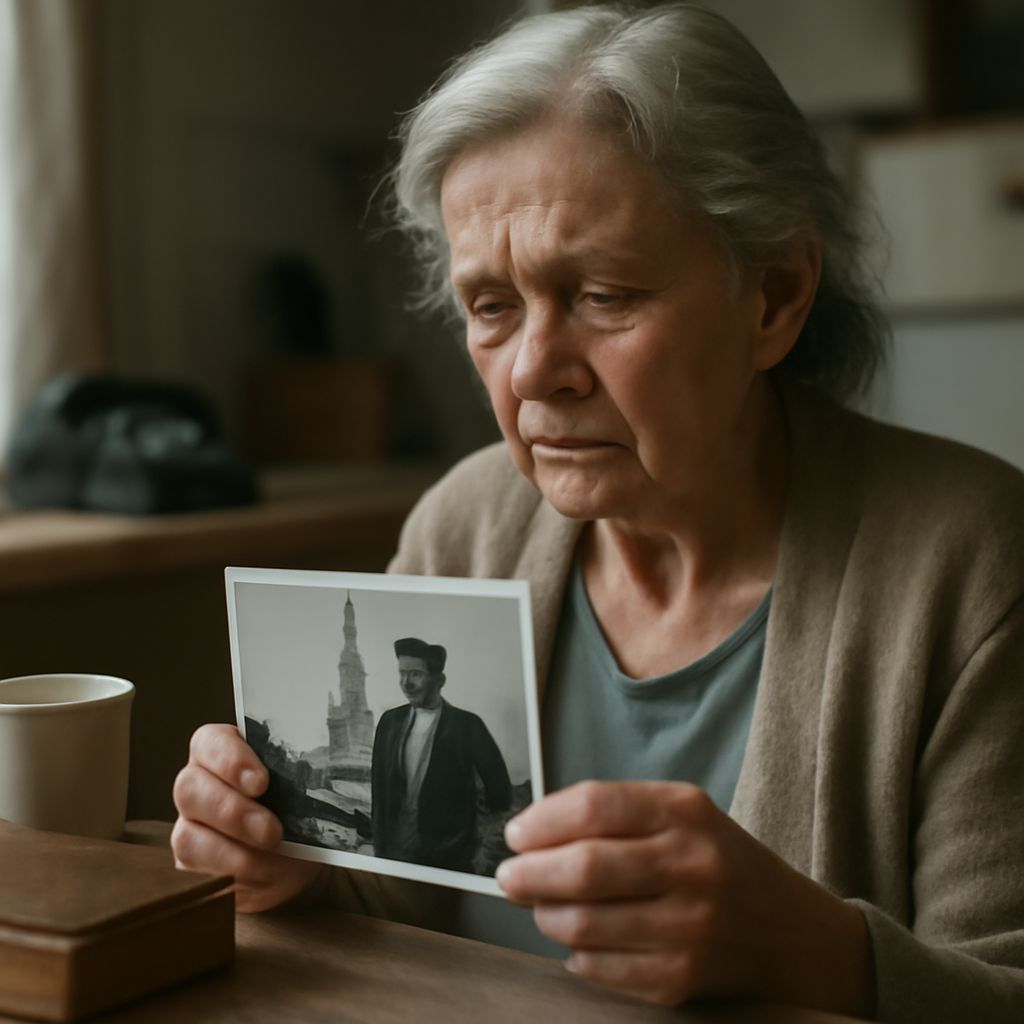
Morning crept softly into the house, brushing the curtains with pale light. Delilah had not slept.
The wooden box sat on the kitchen table, its lid slightly ajar, like an open wound that refused to close. The photograph lay beside her cup of untouched tea — John before the Eiffel Tower, his smile frozen in a moment that didn’t belong to the life she knew.
All night, she had stared at it, waiting for the image to make sense. It never did.
Now, in the clarity of daylight, it looked even stranger. The sunlight caught the glossy surface, revealing faint scratches and a small crease near the edge. But John’s expression — that careless, radiant grin — remained undiminished.
Delilah traced the outline of his face with a trembling finger.
“Paris,” she murmured. “When were you in Paris, John?”
She tried to recall their years together, the early days when they could barely afford groceries, the decades of birthdays, anniversaries, hospital visits, and quiet Sunday mornings. There had been no room for secrets then — or so she’d believed. John had always been steady, reliable, even predictable.
And yet this photo whispered otherwise.
She pushed her chair back and stood. The house felt smaller somehow, as though the discovery had altered its walls. On the counter, a small clock ticked faintly, echoing the rhythm of her thoughts. She needed answers. She couldn’t sit here and let the questions fester.
Her gaze drifted to the old phone on the wall — the same one they had used for decades. One name came to mind.
Margaret.
John’s adoptive sister.
They hadn’t spoken in years, not since the last family reunion — before Margaret’s husband passed and before John’s health began to fail. They’d exchanged Christmas cards, polite and infrequent. Still, if anyone knew about John’s past, it would be her.
Delilah hesitated, her hand hovering over the receiver. It felt wrong to dig into a dead man’s secrets, but it also felt worse to live in ignorance. She took a breath and dialed the number she still remembered.
The phone rang twice before a gentle, weathered voice answered.
“Hello?”
“Margaret?” Delilah said quietly. “It’s me. Delilah.”
There was a brief silence, followed by a soft intake of breath. “Oh, Delilah. I was just thinking about you. How are you holding up, dear?”
Delilah’s throat tightened. “I’m… managing. Some days better than others.”
“I know,” Margaret sighed. “Losing John — it still doesn’t feel real.”
Delilah nodded, though Margaret couldn’t see. “I wanted to ask you something, Margaret. It’s… it’s about John.”
Her voice wavered on his name.
“Of course,” Margaret said gently. “What is it?”
Delilah hesitated, then glanced down at the photograph. “I found something yesterday — in his workshop. A picture. It’s of John, but he’s standing in front of the Eiffel Tower. Paris.”
Margaret didn’t respond right away.
Delilah pressed on. “He never told me he’d been to France. I don’t understand. Did he ever mention it to you? Maybe before we met?”
The line went quiet except for the faint hum of static. When Margaret spoke again, her voice was lower, careful.
“No, he never told me that. But, Delilah…”
“Yes?”
“There’s something I think you should know.”
Delilah’s stomach tightened. The tone in Margaret’s voice wasn’t casual; it carried weight, like a door about to open onto something she couldn’t unsee.
“When John came to live with us,” Margaret said slowly, “he was thirteen. The adoption agency told our parents that he had… a twin brother. They’d been separated in the foster system. No one knew where the other boy ended up. He was listed as missing.”
For a moment, Delilah couldn’t breathe.
“A twin?” she whispered. “John had a twin brother?”
“Yes.”
Margaret sighed again. “He didn’t talk about it. Not once. I don’t think he ever wanted to. Maybe he thought his brother was gone for good. I suppose, after the adoption, he wanted to start fresh. Forget the pain.”
Delilah’s mind raced. The photo, the hidden box, John’s silence — the pieces began to form a pattern she wasn’t ready to see.
“Margaret… are you saying the man in this photograph might not be John at all?”
“It’s possible,” Margaret said quietly. “Or maybe it is John — with his brother. I can’t say for sure.”
Delilah gripped the edge of the table, her pulse pounding in her ears. “Why didn’t he tell me? Why keep something like that hidden for so long?”
“I don’t know,” Margaret said. “But it must have been painful for him. You know how he was — he carried things deep inside, never wanted to burden anyone.”
Delilah swallowed hard. “All these years… and he never said a word.”
“Maybe he thought it didn’t matter anymore,” Margaret replied gently. “But you deserve to know. If you want, I can look through the old papers my parents kept — there might be something there. A record, a name, something.”
Delilah’s voice softened. “Thank you, Margaret. I’d appreciate that more than you know.”
After they hung up, Delilah remained seated, staring at the silent phone. Her hands were trembling, but she didn’t notice. The truth had shifted again, just when she thought she’d reached the edge of it.
A twin brother.
For fifty years, she’d been married to a man she thought she knew entirely — and now, she wasn’t sure who he had been at all.
She picked up the photograph once more, studying every detail. The smile. The glint of sunlight on his hair. The faint shadow behind him that she hadn’t noticed before. The figure standing several feet away — blurred, but human. Another man. Similar build. Similar height.
Her breath caught.
Could it be him? The missing brother?
The thought filled her with a strange mixture of awe and dread. She felt like she was standing on the edge of a cliff, looking down into a past that had been buried for decades.
She ran her thumb along the edge of the photo, feeling the slight fray of the paper. Somewhere in the distance, a church bell chimed eleven times.
“Why didn’t you tell me, John?” she whispered. “Why keep him a secret?”
Her voice trembled with something beyond grief — it was betrayal, confusion, love, and longing all at once.
She tried to imagine John as a child: frightened, alone, separated from his brother, shuttled from one foster home to another. Maybe that was why he rarely spoke of his childhood. Maybe he had tried to erase it, to build a life with her that wasn’t haunted by the past.
But if that was true, why had he kept the photograph?
Delilah leaned back in her chair, closing her eyes. The memory of John’s last days came rushing back — the hospital room, the soft beeping of the monitor, his hand cold in hers. He had said so little then, only murmured her name and one strange phrase she hadn’t understood: “Don’t open the box yet.”
She had assumed he was delirious. Now, it chilled her.
She opened her eyes and looked around the room. The morning light had shifted, slanting across the table and catching on the edge of the photograph. It seemed to shimmer faintly, as if it were alive.
Delilah exhaled slowly. “Alright, John,” she said. “If you won’t tell me, I’ll find out myself.”
She rose, fetched her address book, and flipped through the brittle pages until she found the number of the local library. She would start there. Perhaps there were old records, newspaper archives — something about missing children, or foster placements from the 1940s. Anything that could tell her where John came from.
Her hands shook as she wrote a note for herself:
“Call Margaret again. Ask about adoption papers.”
She set the note beside the photograph and stared at them both — the past and the present, sitting side by side on the table.
For the first time since John’s death, Delilah felt a spark of something unfamiliar: not just grief, but purpose.
She had lived her life quietly, content to let the past remain the past. But now, the walls of her world had cracked open, revealing another life hidden just beyond reach — a life she was determined to uncover.
The kettle on the stove began to whistle softly, but she didn’t move to stop it. Her eyes were fixed on the photograph.
Somewhere inside her, a question had taken root — one that would not let her rest:
If John had a brother, was he still alive? And if he was… did he know about her?
The thought both terrified and thrilled her.
As the whistle grew louder, Delilah stood and reached for the wooden box. She slipped the photograph back inside, her fingers lingering on the lid before closing it. The faint engraving caught the light again — now she could read it more clearly: a single letter, M.
She frowned.
Not J — M.
The air in the kitchen seemed to thin.
“M,” she whispered. “Who are you?”
Her reflection stared back at her in the dark window — small, frail, but steady. The kettle continued to scream behind her, filling the silence that John had left behind.
Delilah turned off the stove and looked once more at the wooden box, her heart thudding in her chest.
The answers were out there, hidden in the spaces between memory and truth.
And for the first time in her long, quiet life, Delilah Davis decided she would no longer be afraid of the noise that came with opening doors best left closed.