Chapter Eleven: The Paris Connection
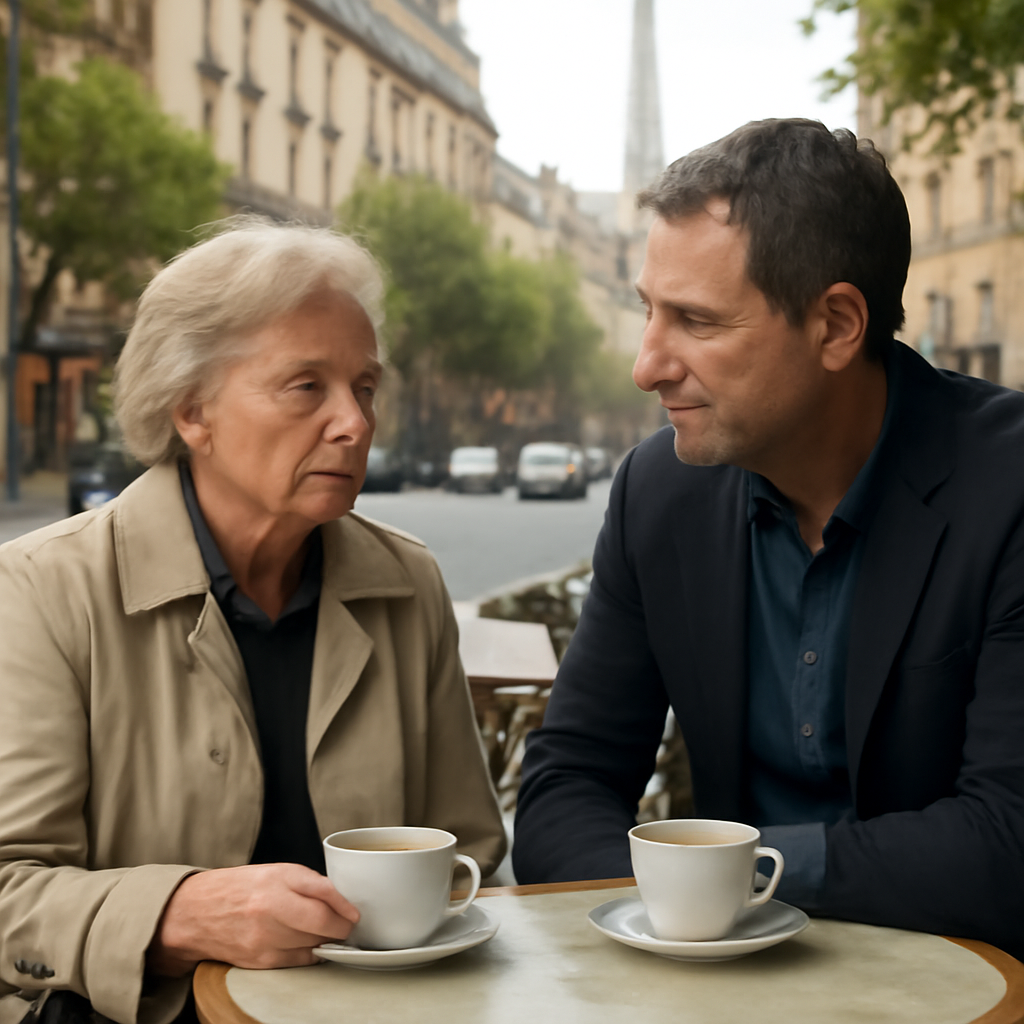
The next morning, Paris shimmered under a fragile light. The sky was washed clean by night rain, and the Seine gleamed like a silver ribbon beneath the bridges. Delilah sat at a café terrace, her hands wrapped around a cup of steaming coffee. The air carried the scent of roasted beans and wet stone, mingling with the faint sound of church bells in the distance.
Her suitcase rested by her feet, the wooden box now gone, surrendered to the river. In its place, a quiet stillness had settled inside her — not peace exactly, but something close to acceptance.
For the first time in weeks, she felt the faint relief of having no more secrets to chase. The truth, terrible as it was, had been found.
She had loved Michael — not John — and he had loved her back with the full, trembling heart of a man seeking redemption.
And yet, even now, she couldn’t help but wonder whether some part of John had lived on through him — as if the two brothers had fused, in grief and memory, into a single soul that had found its way to her.
She sipped her coffee slowly, letting the warmth spread through her. Around her, the city was coming to life: shopkeepers rolling up shutters, delivery men unloading bread crates, a child laughing as he ran after a pigeon. Paris moved forward, unbothered by the ghosts she carried.
But Delilah knew her time here was ending.
Her son David arrived just after noon.
She spotted him through the café window — tall, broad-shouldered, his familiar stride softened by concern. He looked almost exactly like his father had at forty. Or perhaps, she thought now, like his uncle. The resemblance stung and soothed her all at once.
When he saw her, his face broke into relief. “Mom,” he said, kneeling beside her chair. “God, I’ve been so worried. You stopped answering calls.”
“I’m sorry, darling,” she said, touching his cheek gently. “I needed time to think.”
David pulled out a chair and sat across from her, searching her face. “You look… different,” he said softly. “Calmer, maybe.”
“I suppose I am,” she said. “I found what I came for.”
His brow furrowed. “The photograph? The letters?”
“All of it,” she said. “And more.”
She hesitated, her eyes drifting toward the river visible at the end of the street. “I found out who your father really was.”
David froze. “What do you mean?”
Delilah met his eyes, her voice steady. “The man we buried — the man you called Dad — wasn’t John. It was Michael.”
For a moment, David didn’t move. The words seemed to hang between them, suspended in the hum of city noise.
“That’s not possible,” he said finally, his voice quiet, almost pleading.
“I thought so too,” she said gently. “But the records, the adoption files — they were clear. There was an accident, or something worse, at the river in 1963. John died. Michael took his name.”
David’s hands clenched on the table. “So he lied to you. To all of us.”
“He didn’t just lie,” she said softly. “He lived with guilt. Every day, he carried his brother’s death — and tried to make amends by living the life John was supposed to have.”
David shook his head, anger flickering in his eyes. “So what was real then? Our family? Me?”
Delilah reached across the table, taking his hand. “Everything was real,” she said firmly. “He loved us. Whatever name he used, that love was the truest thing in his life.”
David looked away, blinking hard. The city blurred around him. “I don’t know how to process that, Mom.”
“Neither do I,” she admitted. “But maybe we don’t have to, not all at once.”
They walked along the river for a long time after that, side by side in silence. The water shimmered beneath the bridges, and the wind tugged gently at their coats.
Eventually, David asked, “Why did you come here alone?”
Delilah smiled faintly. “Because I didn’t want anyone to stop me. I needed to see it through — for him, for me.”
“And now?”
“Now I’m ready to go home,” she said. “But before that… there’s one last thing I want to do.”
He raised an eyebrow. “What’s that?”
She nodded toward a narrow street that led away from the river. “There’s someone I need to meet.”
The Musée de la Photographie Historique looked different in daylight — warmer, less haunting. The archivist, the same woman who had helped her days before, greeted them with a knowing smile.
“Madame Davis,” she said. “You came back.”
“Yes,” Delilah said. “And this is my son, David.”
The archivist shook his hand warmly. “Your mother is remarkable,” she said. “Few people have the courage to follow history where it leads.”
Delilah smiled softly. “I’d say I was just stubborn.”
The woman laughed gently. “That too.”
She led them to a table in the back room where several files were already waiting. “I thought you might return,” she said. “And I found something you missed.”
Delilah’s breath caught. “Something more?”
The archivist nodded, opening a thin envelope. Inside was a small black-and-white photograph — a candid shot of two men walking away from the camera along the Seine. One wore a dark coat, the other a lighter one. They looked almost identical.
“Taken the same day as your photograph,” the archivist said. “Same studio watermark, same roll of film.”
Delilah’s eyes filled with tears. The brothers — side by side. No confrontation, no violence. Just two men walking together, caught in an unguarded moment of reconciliation.
David leaned closer. “That’s Dad,” he whispered.
“Both of them,” Delilah said. Her voice trembled. “Maybe the moment before everything changed.”
The archivist smiled softly. “Sometimes history only remembers the tragedy. But the camera — it remembers everything else too.”
Delilah reached out, tracing the outline of their figures with a trembling finger. For the first time, the photograph didn’t feel like a riddle. It felt like a memory — one she could finally make peace with.
That evening, as the sun began to set, mother and son sat together on a bench overlooking the river. The air was cool, the light turning gold.
David broke the silence first. “You know,” he said quietly, “I think he must’ve known you’d find out one day.”
Delilah smiled faintly. “Maybe he hoped I wouldn’t.”
“Maybe,” David said, “but he also knew you better than anyone. You were never one to let things stay buried.”
She chuckled softly. “You sound like him.”
He looked at her then, eyes bright with something between sadness and love. “No, Mom. I sound like you.”
They sat together as the light faded, the hum of the city around them — a blend of laughter, footsteps, and the gentle rush of the river below.
Delilah thought of John, of Michael, of the long chain of choices that had bound them all together. Love, guilt, forgiveness — none of it simple, all of it real.
At last, she whispered, “He wanted to be remembered for the life he lived, not the name he carried. I think that’s what I’ll remember.”
David nodded. “Then that’s how we’ll tell it.”
Later, as night fell and the city’s lamps flickered on, Delilah stood one last time at the edge of the bridge. The water shimmered below, endless and alive.
She closed her eyes and whispered a prayer — not for forgiveness, but for peace.
The past was no longer her prison. It was her inheritance — a story of love strong enough to survive its own lies.
When she turned back toward her son, her face was calm, her eyes steady. “Let’s go home,” she said.
And together, they walked away from the river, their shadows stretching long behind them — two figures bound not by blood, but by truth finally set free.