Chapter Fourteen: Two Graves
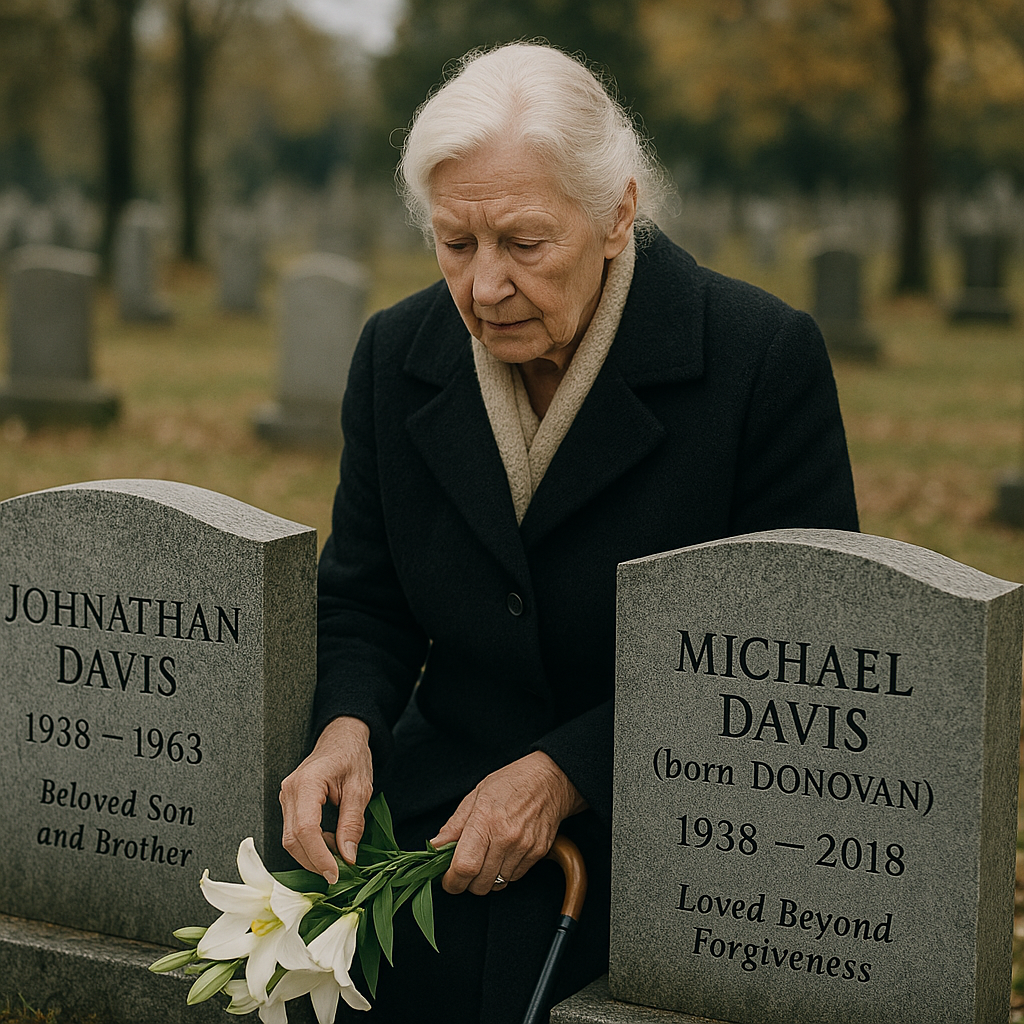
The wind that morning carried the scent of autumn — crisp, cool, touched with the faint sweetness of decaying leaves. Delilah walked slowly up the gravel path that wound through the old cemetery, her cane tapping softly against the stones. The sky above was a pale gray, veiled by thin clouds that softened the sun’s light into something gentle and forgiving.
It had been a month since she returned from Paris, yet the city still lingered inside her — its bridges, its rain, its quiet ghosts. The truth she had found there had not broken her, as she once feared. It had reshaped her. The weight of deception had become, somehow, the weight of understanding.
Now she had come to give it all a resting place.
The cemetery was quiet, save for the rustle of wind through the trees and the distant cry of a crow. Rows of headstones stretched out like the pages of a forgotten book, each name a story once lived and loved.
She carried a bouquet of white lilies — his favorite flowers, or so she had believed for years. Perhaps they had been Michael’s. Perhaps John’s. Perhaps, by now, it didn’t matter.
When she reached the gravesite, she stopped.
Two identical headstones stood side by side, their surfaces worn smooth by time and weather. One read:
Johnathan Davis
1938 – 1963
Beloved Son and Brother
The other, newer stone beside it bore a name she had chosen only weeks ago, after returning from Paris:
Michael Davis (born Donovan)
1938 – 2018
Loved Beyond Forgiveness
Delilah set the flowers down between them, her fingers brushing the cold marble. The gesture was small, but it felt like the closing of a circle that had taken a lifetime to complete.
For years she had spoken to one grave, not knowing another waited in silence. Now she spoke to both.
“You fooled me, you know,” she said softly, her voice carrying just above the wind. “But I think I understand why. Maybe you wanted to keep the best parts of him alive. Or maybe you just wanted a second chance to be loved without the weight of guilt.”
She knelt slowly, her knees protesting the motion, and placed her palm flat on the grass.
“I forgive you,” she whispered. “Both of you.”
The words trembled in the air for a moment before the wind carried them away.
She stayed there for a long time, letting memories drift in and out like the changing light through the clouds.
She remembered John’s — Michael’s — quiet laughter as he read in bed beside her. His hands, roughened by years of work. The way he would pause, sometimes, as if lost in thoughts too painful to name.
There had always been a sadness in him — not visible to most, but clear to her, even in the early years of their marriage. She had mistaken it for nostalgia, for the simple melancholy of age. Now she understood it for what it was: penance.
He had loved her fiercely, but part of him had always belonged to the brother he had lost.
And now, somehow, she loved them both.
She took a small envelope from her coat pocket — her own letter, written the night before. The paper was creased, her handwriting shaky, but the words were steady.
To the brothers who shared a name, a face, and a life of borrowed time —
I once thought love was about truth. Now I know it’s also about mercy. The truth broke me, but mercy stitched me back together. You were both part of my story, and I wouldn’t erase either of you for the world.
I forgive the lies, the silence, the fire, and the water that took you. I forgive the fear that kept you apart, and the guilt that kept you alive.
Rest now. Both of you. I’ll carry what you couldn’t.
She folded the letter and placed it between the headstones, weighing it down with a smooth river stone she had brought back from Paris — from the bank of the Seine.
“There,” she murmured. “Now you’ll always be connected.”
The crunch of footsteps on gravel made her turn. David was walking toward her, a bouquet of sunflowers in his hand. His expression was quiet, contemplative, the wind tousling his hair.
“I figured you’d be here,” he said softly.
“I didn’t want to leave them alone,” she said, standing slowly.
David crouched beside the graves, arranging the flowers with care. “You did the right thing,” he said after a while. “Bringing him home.”
Delilah nodded, her eyes tracing the two names carved in stone. “For a long time, I didn’t know which one I was talking to when I prayed. Now I can talk to both.”
David looked at her thoughtfully. “Do you hate him? For lying?”
She smiled faintly. “No. He didn’t lie to hurt me. He lied to keep living. Sometimes love and survival look the same.”
David nodded, his throat tightening. “You’re stronger than I thought.”
Delilah chuckled softly. “No, darling. Just older.”
They stood together in silence, the kind that didn’t need filling. The air was cool, the kind of stillness that comes when grief has learned to coexist with gratitude.
After a while, David slipped his arm around her shoulders. “What now?” he asked.
“Now,” she said, “we live. We remember, but we keep living.”
He smiled, nodding. “He’d like that.”
“I think they both would.”
Later that evening, after David drove her home, Delilah sat by the window in her living room, watching the last light fade over the trees. The house felt lighter now, its silence gentler.
She reached for the small wooden music box that sat on the side table — one of the few things Michael had made with his own hands. When she turned the key, the soft notes of an old lullaby filled the room.
She closed her eyes and listened.
The melody carried her back — to nights in Paris, to the sound of rain on the window, to laughter echoing faintly in the workshop. The past no longer pressed down on her. It drifted beside her, familiar and kind.
When the music stopped, she rose and walked to the window. Outside, the moon had risen — pale and distant, mirrored in the quiet shimmer of the garden pond. For a moment, she thought she saw two reflections side by side, fading into the dark.
She smiled.
A week later, Delilah received a letter from the Musée de la Photographie Historique in Paris. Inside was a short note from the archivist who had helped her.
Dear Mrs. Davis,
We recently finished restoring one of the old negatives you examined during your visit. Enclosed is a copy you may find meaningful.
Thank you for reminding us that even the oldest photographs can still tell new stories.
With respect,
Claire Dufour
Delilah unfolded the photograph carefully.
It was the same image as before — the brothers standing near the Seine. But in this restored version, the light was clearer. The stranger in the background, once just a shadow, now appeared as a man holding a camera — capturing the two of them just as they turned toward him.
It wasn’t a picture of tragedy. It was a portrait of reunion.
Delilah ran her fingertips across the faces — the same eyes, the same expression caught in time.
She placed the photograph in a new frame and set it on the mantel. Between the two graves and this image, the story was finally whole.
That night, she dreamed of the river.
The Seine shimmered beneath a twilight sky. Two men stood at its edge, side by side, their features softened by the glow of sunset. One turned to her and smiled — that familiar, quiet smile that had once been her home.
“Thank you,” he said.
She woke with tears on her cheeks, but her heart was calm.
The past was no longer a wound. It was a story. And she, at last, had reached its final page.