Chapter Thirteen: The Fire
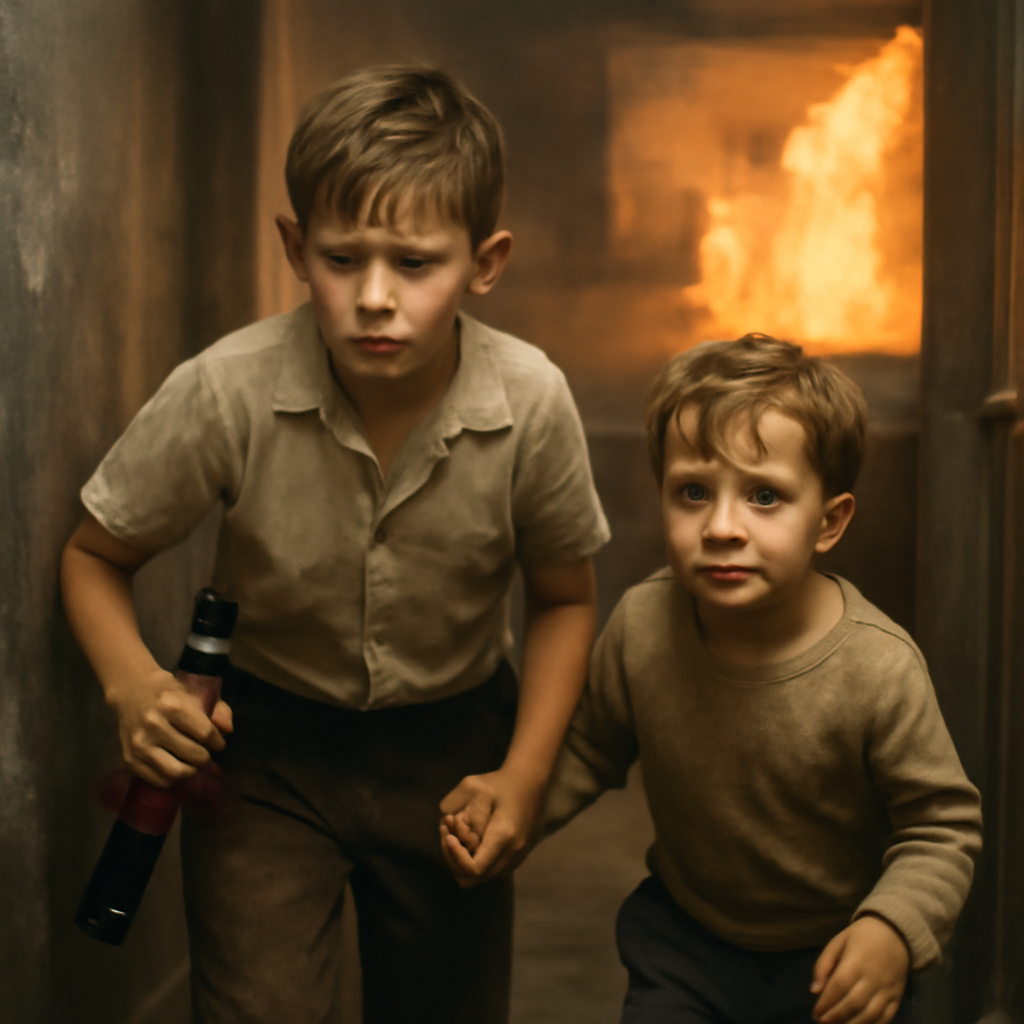
The memory begins in smoke.
Thick, gray, choking — rolling through the corridors like a living thing. The air trembles with heat, the ceiling groaning as flames crawl along the beams. Somewhere, a clock falls from the wall, shattering against the floor.
Two boys run through the hallway, barefoot and terrified. One clutches a wooden toy soldier, the other holds his hand, refusing to let go.
“John!” the smaller boy cries. “It’s coming from the kitchen!”
“Don’t look!” John shouts, pulling him forward. “Stay low — just like Father said!”
The fire roars in reply, a terrible, hungry sound. Shadows flicker across the walls, bright and furious. The smoke burns their throats.
Michael stumbles, coughing hard. John stops, drops to his knees, and pulls him close. “It’s alright,” he says, though his own voice shakes. “We’re almost out.”
He glances toward the door at the end of the hall — just a few feet away, open to the cool night beyond. Salvation. But between them and that door lies a fallen beam, flames licking across it like tongues.
John hesitates. His mind races. Behind them, glass shatters. A woman screams — their mother’s voice, distant and fading.
Michael sobs. “I can’t—”
“Yes, you can.” John grips his brother’s shoulders, forcing him to look up. “On three, you run. Don’t stop. Don’t turn around. Do you understand?”
Michael nods, trembling.
“One,” John says, the smoke burning his eyes. “Two—”
The roof cracks above them.
“Three!”
He shoves Michael forward. The boy leaps over the beam, the heat searing his legs, his arms flailing as he lands on the other side.
John follows — or tries to. But the ceiling gives way, a storm of sparks and timber collapsing around him. A blinding flash, a thunderous crash.
When he opens his eyes again, the air is thick and hot, his ears ringing. He’s trapped beneath a piece of the roof. Through the haze, he sees Michael crawling toward the door, shouting his name.
“John!”
“Go!” John yells. “Go now!”
“But—”
“GO!”
Michael hesitates only a second before obeying. He scrambles through the doorway into the cool night air. A burst of wind catches the flames, fanning them higher.
John closes his eyes. The heat presses in on him. Somewhere beyond the fire, he hears sirens, footsteps, shouting. His vision blurs.
He thinks of his brother — small, scared, safe. He thinks of his mother’s lullaby, the smell of bread baking, the feel of sunlight through the window.
And then, just before darkness takes him, he hears a voice.
“John! I’m coming back!”
He wakes in a hospital. The world is quiet and pale, the air sharp with antiseptic. His skin feels raw, his throat dry.
When he tries to speak, only a rasp escapes.
A nurse leans over him. “You’re awake,” she says gently. “Try not to move.”
He blinks, disoriented. “My brother,” he croaks. “Where’s my brother?”
The nurse’s expression softens. She glances toward the doorway, where a man in a gray coat stands with a clipboard. He approaches slowly.
“Johnathan Donovan,” the man says, reading from a form. “You were found unconscious near the fire. Your parents…” He hesitates. “I’m sorry. They didn’t survive.”
John’s chest tightens. “And Michael?”
The man exchanges a glance with the nurse. “Your brother’s body wasn’t recovered,” he says quietly. “The flames were severe.”
John shakes his head violently. “No. He got out. I saw him.”
The man sighs. “Sometimes, memory plays tricks in trauma.”
“He was alive!” John insists, his voice breaking. “He ran out!”
The nurse places a hand on his arm. “You need to rest.”
But John turns away, staring out the window at the gray morning sky. His mind races. He was alive.
Somewhere out there, Michael was alive.
And John had let him go.
The following weeks blur into motion. Foster homes. Questions. The quiet click of typewriters in social offices. Each adult speaks in gentle tones, but their eyes hold the same judgment — pity wrapped in distance.
John grows quieter. He stops speaking of Michael. When they ask him about the fire, he simply says, “It was my fault,” and refuses to elaborate.
Eventually, he is placed with a new family — the Davises — a kind couple who live on the edge of town. They have no children of their own. Elaine Davis is patient and warm, her husband firm but fair.
Still, the nightmares follow him.
Every night, he wakes to the sound of crackling wood, the smell of smoke. Every morning, he traces the faint burn scar along his wrist and remembers the hand he failed to hold onto.
And somewhere inside him, guilt grows like ash.
Years later, in the summer of 1959, John — now a young man — receives a letter. The return address is a name he doesn’t recognize: Henry Caldwell, Northbridge Adoption Agency.
He opens it hesitantly.
Mr. Donovan,
We have located a record that may interest you. It concerns your brother, Michael Donovan. According to our files, he survived the fire and was later relocated through an international adoption program to Lyon, France. Should you wish to make contact, arrangements can be made.
John’s vision blurs. He reads the letter twice, then a third time.
Alive.
Michael was alive.
He presses the letter to his chest, tears burning his eyes. For years, he has lived with guilt — believing his brother had died because of him. Now, the world tilts again.
He spends the next weeks writing letters, waiting for replies. Months pass before he receives one, written in careful French, translated by an agency worker.
John,
I remember the fire. I remember you shouting for me to run. I hated you for years for staying behind. But I never forgot your face. I’m in Paris now. Come if you want. But I don’t know what forgiveness looks like anymore.
— Michael
John doesn’t hesitate. He sells what little he owns, boards a ship across the Atlantic, and arrives in France with a small suitcase and too many ghosts.
Paris, 1963.
They meet for the first time in fourteen years on the Pont de Bir-Hakeim — the bridge over the Seine.
John spots him immediately. Michael stands near the railing, older but unmistakable — the same eyes, the same scar near his temple.
“Michael,” John says softly.
His brother turns. For a moment, neither speaks. The air between them feels heavy, charged with years of silence.
“You came,” Michael says finally.
“I had to.”
Michael studies him. “Do you know how long I waited? How many nights I thought you were dead?”
“I thought you were,” John whispers. “They told me you’d burned.”
Michael lets out a shaky laugh. “We both did, didn’t we?”
John steps closer. “I’m sorry.”
“For what?” Michael snaps. “For living? For letting me think I was alone?”
“I tried to find you—”
“Not hard enough.”
The words sting. John’s throat tightens. “Then why did you write me?”
Michael’s voice softens. “Because I wanted to see your face again. To know you were real. And because I wanted to forgive you… but I don’t know how.”
John’s eyes fill with tears. “Then let me try.”
They stand in silence, the city humming around them. A photographer nearby raises his camera, snapping a candid picture — two brothers, identical, both caught between love and loss.
It is that photograph that will outlive them both.
Moments later, a sound — shouting, footsteps, the flash of movement behind them. The third man, the one Delilah would one day discover in the background.
The details blur in memory. A struggle. A slip. A fall.
Water, cold and endless.
When Michael opens his eyes, he is alone. His brother is gone.
And in the years to come, guilt will drive him to live under the only name that still feels alive.