Chapter Four: The Call
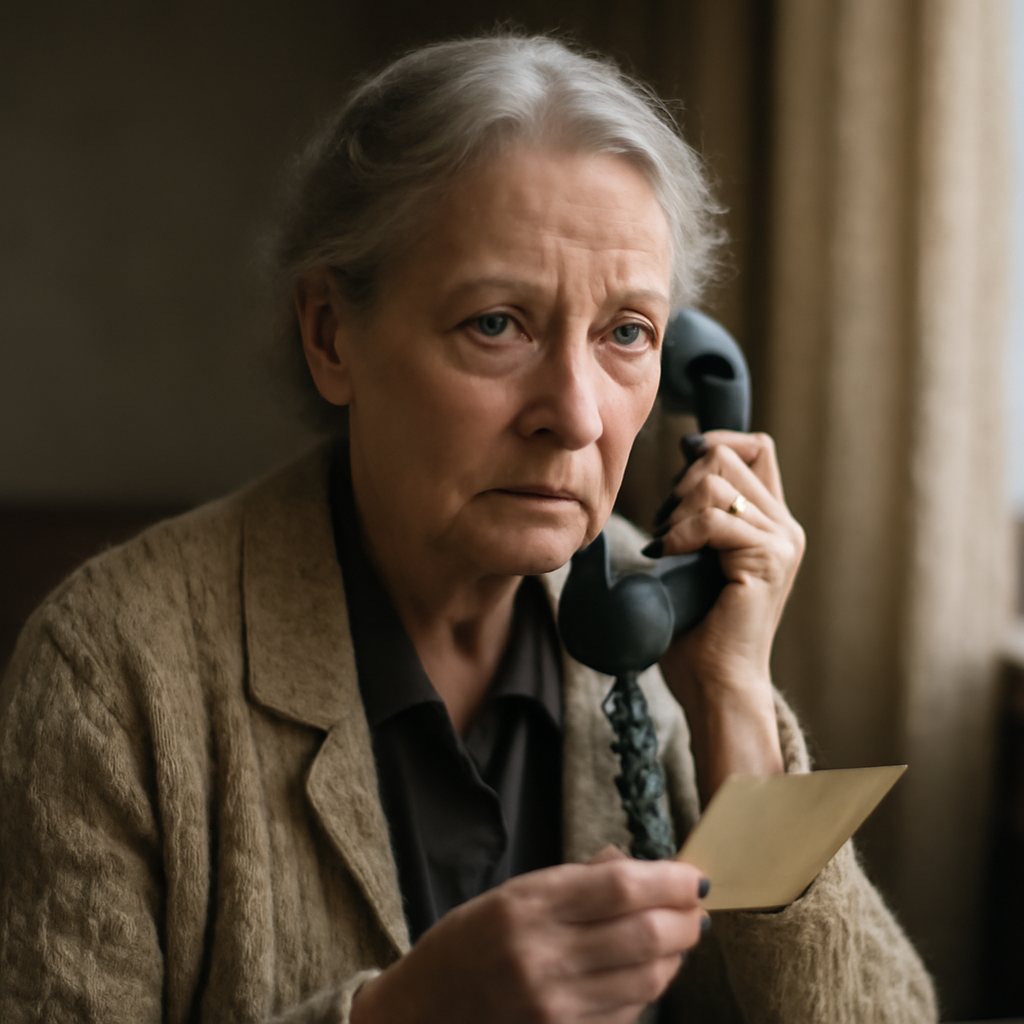
The rain had been falling since dawn, a steady rhythm against the windows that made the house feel smaller and quieter than usual. Delilah stood by the window, watching the gray morning swallow the garden. The world outside blurred into watercolor — soft, indistinct, unreachable.
On the table behind her lay the letter she had found the day before — John’s confession, his trembling handwriting still vivid in her mind. “If you find him — or the truth — forgive me.” Those words had kept her awake through the night.
She turned away from the window, her reflection faint in the glass. The woman staring back at her looked older than she remembered. Grief had carved new lines into her face, but behind the tired eyes there was something else now — purpose.
She crossed the room and picked up the phone. The number she wanted was written on a slip of paper beside the letter: Margaret’s.
Delilah hesitated before dialing. She wasn’t sure what she wanted to say. She only knew she needed to speak to Margaret again — needed to know if the faint thread connecting John and his brother could still be followed.
The line rang twice before Margaret’s voice answered, soft and cautious.
“Hello?”
“Margaret, it’s me again,” Delilah said. Her voice was calm, but her heart was pounding.
“Delilah! I’ve been thinking about you,” Margaret replied. “After we spoke, I went through some of my parents’ old boxes. I found a few papers you might want to see.”
Delilah’s breath caught. “You did?”
“Yes. There’s not much, but I think you’ll want to hear it. Do you have a moment?”
Delilah sank into the nearest chair, gripping the receiver tightly. “Please. Tell me everything.”
There was the faint rustle of papers on the other end. “Most of the adoption records were destroyed or sealed, but my mother kept a small folder. Inside was a copy of John’s intake file — and a note written by the social worker at the time. It mentioned that the twins were separated after their parents died in a house fire.”
Delilah closed her eyes. “A fire…”
“Yes,” Margaret continued. “Apparently the boys were found in the ruins of their home. The younger one — Michael — was injured and sent to a different hospital. After that, the records split. John was transferred to one foster home, Michael to another, and there’s nothing after that.”
Delilah’s fingers tightened around the phone. She remembered the line from John’s letter — “We were together when the fire happened. I survived. He didn’t… or so I thought.”
Her voice trembled. “So he might have lived. Michael might have survived after all.”
“It’s possible,” Margaret said. “But there’s more. The social worker’s note said that one of the boys — she didn’t specify which — was later relocated overseas, possibly through a special adoption program. It mentioned France.”
Delilah felt her pulse quicken. “France,” she repeated. “Paris.”
“Yes.”
For a long moment, neither woman spoke. The sound of the rain filled the silence between them, gentle but relentless.
Finally, Delilah said, “Do you think that’s where the photograph came from? Could it have been taken when they met again?”
“It could be,” Margaret admitted. “I wish I knew for certain. But, Delilah, if that’s true, it means John must have found him — or at least tried to.”
Delilah pressed a hand to her chest. The thought of John searching for his brother, of carrying that secret alone for decades, broke something inside her.
“He should have told me,” she whispered.
“I know,” Margaret said softly. “But maybe he wanted to protect you. Some wounds never close, and John… he carried guilt like armor. I think he believed silence was a form of love.”
Delilah smiled faintly, though tears stung her eyes. “That sounds like him.”
There was another pause. Then Margaret said quietly, “Delilah, if you really want to know what happened to Michael, there’s someone you might contact — a man who used to work for the adoption agency before it closed. He handled international cases back then. I can give you his name.”
“Please,” Delilah said quickly. “I’ll take anything.”
His name was Henry Caldwell, Margaret explained, now retired but still living in a small town a few hours away. He might not remember everything, but if anyone had access to the old transfer logs, it would be him.
Delilah wrote the name carefully on the corner of John’s letter, as if adding a new chapter to a story that had long been unfinished.
“Thank you, Margaret,” she said softly. “You’ve done more for me than you know.”
“Promise me something, Delilah,” Margaret said. “Whatever you find — don’t let it consume you. The past can take more than it gives.”
Delilah nodded, though she knew Margaret couldn’t see it. “I’ll be careful.”
After she hung up, she sat for a long time, staring at the phone in her hand. Henry Caldwell. A new lead. A new beginning.
The rain had slowed outside, tapering into a fine mist. She rose from the table, her mind already moving ahead. The road to answers had opened, and for the first time, she felt ready to walk it.
The drive took her through winding country roads, past wet fields and skeletal trees. The clouds hung low, pressing against the horizon like a lid. John would have loved the smell of rain, she thought. He used to say it reminded him of renewal — of things growing quietly after being broken.
After nearly two hours, Delilah reached a small town that looked untouched by time. The streets were lined with brick buildings and faded signs. She parked near a modest house with a peeling white fence. A brass plate by the door read: Henry Caldwell.
She hesitated before knocking. Her reflection in the glass pane beside the door looked uncertain, fragile. But she lifted her hand and knocked anyway.
The door opened a crack. A tall, thin man in his late seventies peered out, his eyes sharp behind round spectacles.
“Yes?”
“Mr. Caldwell?” Delilah asked. “My name is Delilah Davis. I believe you once worked with the Northbridge Adoption Agency.”
He studied her face for a moment before nodding. “Many years ago, yes. Why do you ask?”
“I’m looking for information about a case from 1956,” she said. “Two brothers — twins — separated after a house fire. One of them was adopted by the Davis family.”
His expression shifted slightly, recognition flickering in his eyes. “Ah. The Davis case.” He stepped aside. “Come in.”
The house was small and tidy, smelling faintly of old books and lemon polish. Delilah followed him to a study cluttered with papers and boxes. He motioned for her to sit while he shuffled through a drawer.
“I remember the case,” he said after a moment. “Not many twin adoptions happened back then. The files were complicated — tragic, really. One boy was relocated to a family overseas, part of a partnership with a European adoption program. France, if I recall.”
Delilah’s hands tightened around her purse. “Do you remember his name?”
Caldwell frowned, pulling out a faded ledger. “Let’s see… yes. Michael Donovan. Adopted by a couple in Lyon. The records indicated that correspondence stopped after 1960. No follow-up.”
“Do you know what happened to him?” she asked.
He shook his head. “I’m afraid not. International adoptions back then were… poorly documented. Once a child left the country, the paper trail often ended.”
Delilah’s shoulders sagged. “So he could still be alive.”
“It’s possible,” Caldwell said gently. “But after so many years, I wouldn’t expect the records to be easy to find.”
Delilah nodded slowly. Her eyes drifted toward a stack of folders on his desk, one marked “ARCHIVES.” “Would it be alright if I took a look?” she asked.
He hesitated, then smiled faintly. “You’re determined, aren’t you?”
“I’ve come this far,” she said simply.
He nodded and handed her the ledger. The pages were fragile, filled with handwritten notes and faded ink. As she turned them carefully, one entry caught her eye — a marginal note beside Michael’s name:
Relocated, 1962. Destination: Paris.
Delilah felt her pulse quicken. “Paris,” she whispered.
Caldwell looked up. “Yes, that’s where his file ends.”
Delilah traced the words with her fingertip, the paper soft beneath her skin. Paris — the same city in the photograph. The same city where her husband’s ghost still smiled in faded color.
She closed the ledger slowly. “Thank you, Mr. Caldwell,” she said, her voice thick with emotion. “You’ve given me more than I expected.”
He nodded. “Be careful chasing the past, Mrs. Davis. It has a way of chasing back.”
The drive home felt different. The rain had stopped, and streaks of gold broke through the clouds, scattering across the wet road. The world looked new, alive again.
Delilah rolled down the window slightly, letting the wind brush her face. Her heart felt heavy but alive — burdened with the truth, yet driven by the need to see it through.
In her mind, she pictured Paris — the narrow streets, the river, the distant silhouette of the Eiffel Tower. Somewhere there, perhaps, lived the last echo of John’s hidden life.
And she would find him.
That night, Delilah placed the photograph, the letter, and her new notes into the wooden box. She closed the lid gently, tracing the engraved M with her fingertip.
“Paris,” she murmured. “That’s where it all began.”
The wind outside rustled through the trees, soft but insistent, as if whispering in agreement.
Tomorrow, she decided, she would book a flight.
For now, though, she sat in the quiet house, surrounded by the ghosts of her past — and for the first time, she wasn’t afraid of them.