Chapter Eight: The Restorer
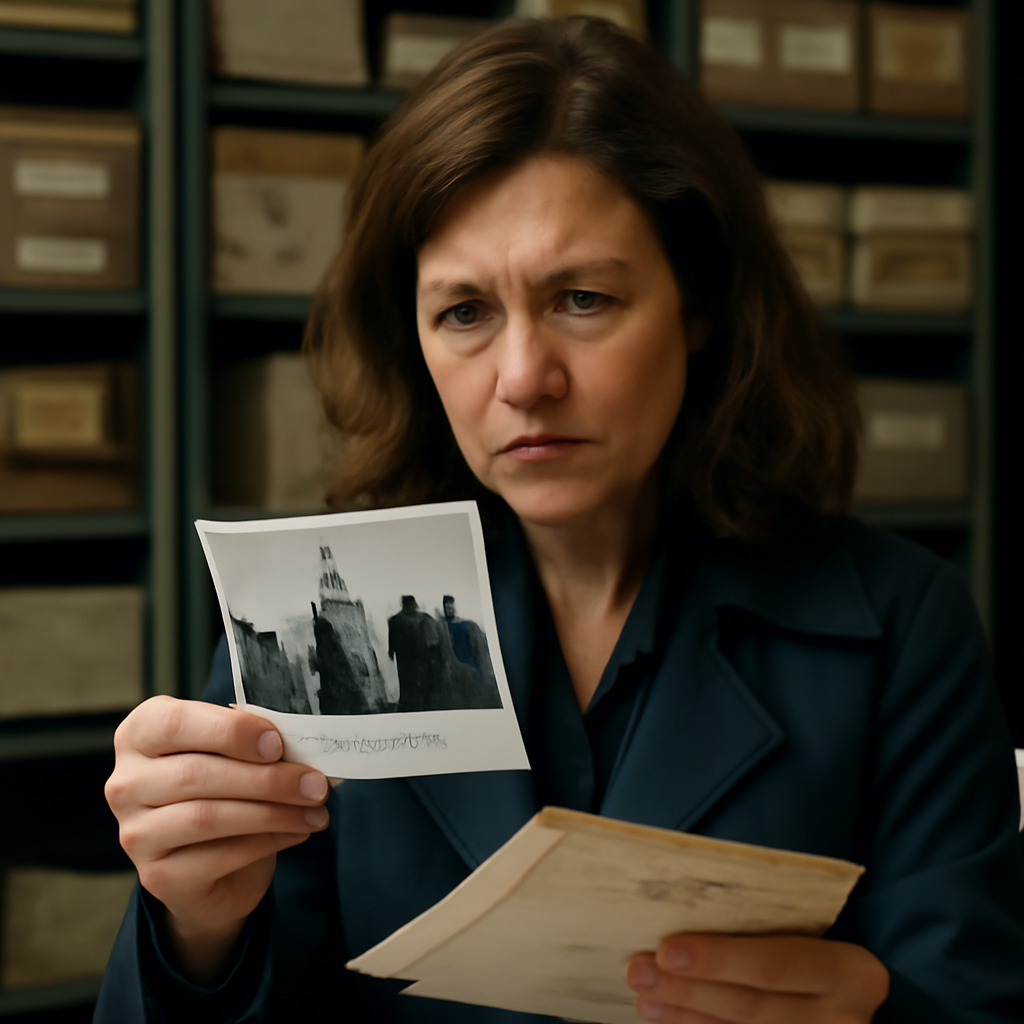
The next morning dawned gray and restless, the kind of Parisian day that seemed suspended between rain and memory. A pale mist drifted over the Seine, softening the edges of bridges and rooftops. Delilah stood at her hotel window, staring out at the faint outline of the Eiffel Tower in the distance.
She couldn’t stop thinking about the photograph.
Three figures — her husband, his twin, and the shadow of a stranger behind them. The image haunted her now, more than any dream. The night had offered no peace, only the echo of her own questions. Who was that man? And what really happened the day the picture was taken?
The city outside looked deceptively calm, but inside her, the storm hadn’t stopped.
She dressed quietly, choosing her navy coat and scarf, then placed the photograph back in its sleeve. The wooden box — now filled with John’s letters, Michael’s note, and her growing collection of evidence — waited on the desk. She hesitated, then opened it once more, running her fingers across the letters inside.
“Tell me the truth, John,” she whispered. “I’m ready to know it.”
By midmorning, she found herself once again at the Marston Restoration Studio. The bell chimed faintly as she pushed the door open. Inside, the same warm light spilled across the workbenches, casting long shadows on the walls lined with antique cameras and stacks of fragile negatives.
Monsieur Lambert looked up from a roll of film he was inspecting. “Ah, Madame Davis,” he greeted with a mixture of surprise and curiosity. “You’ve come back.”
Delilah managed a polite smile. “I’m sorry to trouble you again, but I can’t stop thinking about that photograph. There’s something else I need to know.”
He gestured toward the counter. “Come, sit. You’ve brought it?”
She nodded and handed over the envelope. “I’ve been looking at it for days. But I still don’t understand what it shows — or when it was taken. Do you have any way of finding out the exact date?”
Lambert studied her carefully. “Not from the image alone, no. But perhaps from the material. Photographs from that era — early 1960s — were printed on distinct paper. Some manufacturers used watermarks, chemicals, even production codes.”
He retrieved a small magnifying lens and a handheld light. “Let’s take a look.”
Delilah leaned forward, her fingers clenched tightly together in her lap as he turned the photo under the light.
“Hmm,” he murmured. “This one’s unusual. The paper stock — very fine. French-made, yes, but not the kind used by amateurs. Whoever took this photo knew what he was doing.”
Delilah frowned. “You mean it was taken by a professional?”
“Possibly. Or someone with access to professional equipment. Look here — faint markings near the edge. Galerie Photographique du Pont Saint-Michel. That was a well-known photography studio in Paris. Closed decades ago.”
Her heart leapt. “Could they have kept records?”
Lambert considered for a moment. “If the archives survived, maybe. But I doubt it. The shop burned down in 1963 — a fire, if I remember correctly.”
A fire.
The word seemed to pierce the air between them.
Delilah’s pulse quickened. “A fire,” she repeated. “You’re sure?”
“Yes. It was in all the papers. The owner died trying to save his negatives.”
Delilah stared at the photograph as if it might suddenly burst into flames before her. Fire. Always fire. From the tragedy that had taken John’s parents to the one that might have erased the truth of his past.
“Do you have any idea where I might find their remaining archives?” she asked.
Lambert thought for a moment, then smiled faintly. “You’re persistent, Madame Davis. I admire that. The old studio’s equipment was auctioned off in the seventies. Some of the archives ended up in a museum — the Musée de la Photographie Historique in Montreuil. Perhaps they have something.”
Delilah scribbled the name into her notebook. “Thank you.”
As she turned to leave, Lambert called softly after her. “Be careful, Madame. Photographs don’t lie — but sometimes the truth they hold isn’t what we want to see.”
The museum stood on the outskirts of the city, its façade plain and unassuming. Inside, rows of glass cases displayed vintage cameras, daguerreotypes, and sepia portraits. The air smelled faintly of dust and varnish.
Delilah explained her reason for coming to the archivist, a middle-aged woman with kind eyes and ink-stained fingers.
“I’m looking for records from the Pont Saint-Michel studio,” Delilah said. “Early 1960s, perhaps 1962 or 1963. There might be a copy of a photograph taken near the Eiffel Tower.”
The woman nodded thoughtfully. “We do have some boxes from that studio. Most of the collection was damaged, but we’ve been cataloguing the survivors.”
She led Delilah into a dim storage room where shelves rose high with boxes labeled in fading ink. “Take your time,” she said. “If you find something relevant, call for me.”
Delilah began searching, her hands trembling slightly as she opened each box. Inside were contact sheets, rolls of negatives, studio receipts — fragments of countless forgotten lives.
After nearly an hour, she opened a folder marked 1963 – Outdoor Portraits. Inside were several photographs — families, couples, travelers. And then, her breath caught.
There it was.
The Eiffel Tower. The same angle. The same day.
And in the corner of the image — her husband.
But this one was different. In this print, he wasn’t smiling. His head was turned, eyes fixed on someone beyond the frame. The light in his face was harsh, almost fearful.
Delilah turned the print over. Written faintly in pencil were three words:
Pont de Bir-Hakeim – March 1963.
The same year the studio burned.
Her heart pounded. She searched further through the folder, and beneath a stack of negatives, she found something else — a torn envelope addressed to M. Donovan. The handwriting was neat, European. Inside was a receipt for a photograph — dated March 15, 1963 — purchased by “Mr. M. Donovan.”
Her vision blurred. Michael.
She clutched the paper to her chest. Her husband’s brother had ordered the photograph.
Which meant — it wasn’t John who had been photographed at all.
It was Michael.
Or both of them.
She sank onto a nearby chair, her thoughts spiraling. If Michael had taken or purchased the photo, then John must have been there too. Perhaps they had met that day. Perhaps the photograph captured their final encounter — a meeting that ended not in forgiveness, but in something darker.
Her gaze drifted back to the image. That shadow behind them — the third man. He wasn’t a bystander. He was close enough to touch them.
A horrible thought began to form in her mind.
What if John hadn’t left Paris because he couldn’t bear the memory — but because something had happened there?
Something that had never been spoken aloud.
By the time she returned to her hotel, the sky was already fading into twilight. The streets glowed gold and silver with the reflection of rain-soaked lamps.
Delilah closed the door behind her, her chest heavy with revelation. She set the new photograph on the table beside the original, comparing them under the warm light of the lamp.
One — John smiling, carefree. The other — serious, tense, watching.
Two versions of the same man. Two truths staring back at her.
Her eyes drifted to the faint handwriting on the back: Pont de Bir-Hakeim – March 1963.
That bridge. That date.
She reached for her notebook, flipping to a blank page. “March 1963,” she wrote. “Pont de Bir-Hakeim. John. Michael. Third man. Fire.”
Then, as she stared at the words, something else surfaced in her mind — a sentence from one of John’s old letters: If you ever see me in Paris again, it means I failed to forget.
Delilah closed her eyes, tears welling. “You didn’t fail, John,” she whispered. “You just couldn’t forgive yourself.”
She sat there for a long time, the photographs laid out before her like pieces of a puzzle, the candle flickering low. Outside, the city murmured — the heartbeat of strangers, the whisper of rain.
And somewhere deep within her, a new certainty began to take root.
The truth wasn’t finished revealing itself.
There were still shadows to follow — and she was ready to face them.