Chapter Seven: Shadows in the Photo
Paris was quieter in the early hours — the streets washed clean by last night’s rain, the air heavy with the scent of damp stone and coffee drifting from unseen cafés.
Delilah walked slowly along the Rue des Carmes, her coat buttoned to the collar, the wooden box tucked securely under her arm. The city seemed gentler in the morning light, yet she felt the familiar pull of unease threading through her chest.
Sleep had eluded her. The letters she’d found in the antique shop still lingered in her mind — John’s trembling words, Michael’s sharp reply, I forgive you. Forgiveness. Such a small word for so much pain.
But something about it felt unfinished, like a story missing its final line.
At breakfast, she had spread the photograph across the little café table beside her croissant and coffee. She had studied it before, countless times now, but the letters had changed the way she saw it. Before, it had been a mystery. Now, it was a message — and she was certain it still had more to tell her.
The café owner, a kind-eyed woman with a lilting accent, noticed her staring. “That photo,” she said curiously, “your family?”
Delilah looked up, hesitating. “My husband,” she said after a pause. “And… someone who looks just like him.”
The woman leaned closer, smiling faintly. “A brother, maybe?”
“Yes,” Delilah murmured. “A brother.”
She didn’t explain further. How could she? How could she tell a stranger that the man in the background might not only be her husband’s brother, but also the shadow that haunted his entire life?
When the woman left to serve another customer, Delilah leaned closer to the photograph again. The light from the window fell across it, revealing faint scratches on the surface — details she hadn’t noticed before. And there, in the lower corner, almost invisible beneath years of wear, something glinted.
A small reflection. A shape.
She squinted. It looked like a metallic object — something cylindrical, half-hidden by the edge of the frame. A camera? No, smaller. Perhaps a lighter. Or… a weapon?
A chill passed through her.
Delilah turned the photo over, studying the back again. Still blank. No handwriting, no clue. She slipped it into her bag and took a deep breath. She needed to see it under professional light again.
That afternoon, she returned to the Marston Restoration Studio, the same shop that had confirmed the presence of the second figure — the twin. The bell chimed softly as she entered.
The restorer, Monsieur Lambert, looked up from his workbench. “Madame Davis,” he said with a smile of recognition. “Back so soon?”
“I need your help again,” Delilah said, removing the photograph from her bag. “I think there’s something more — something I missed.”
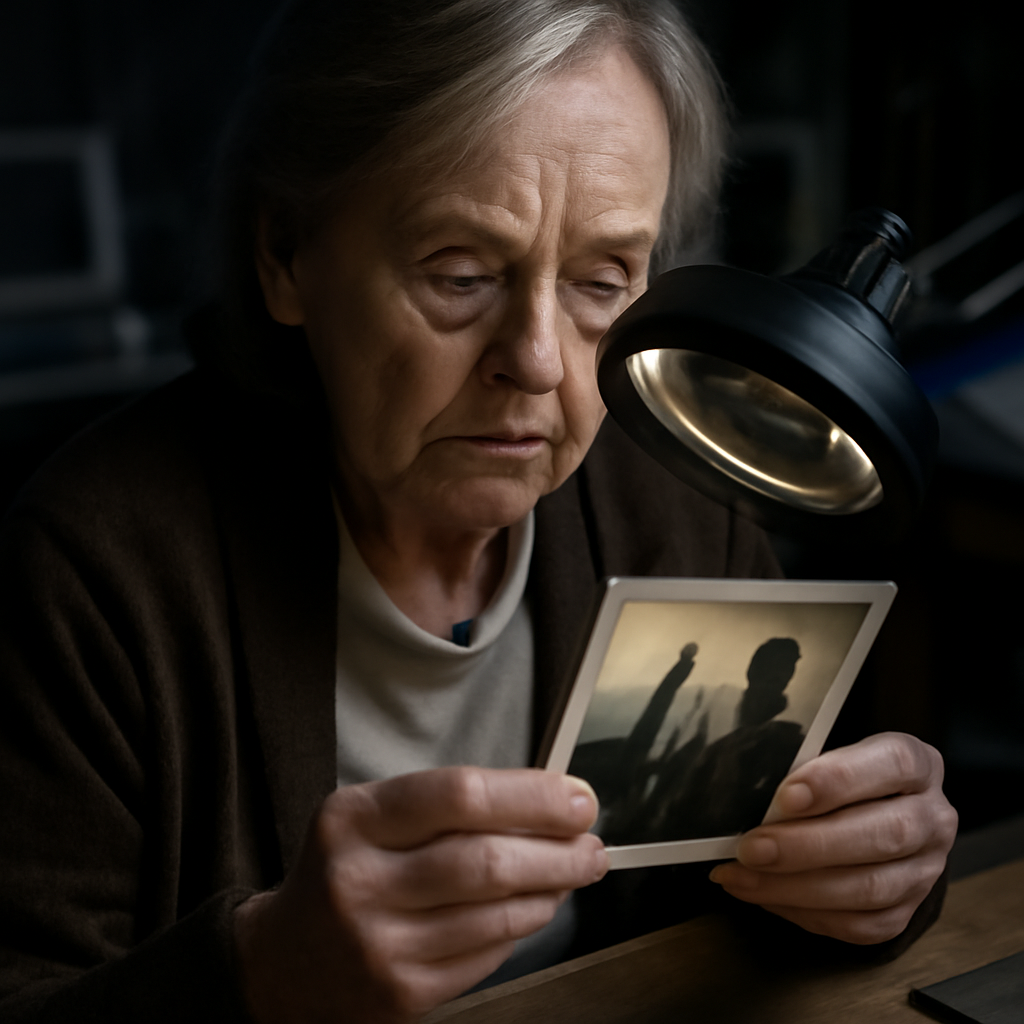
He gestured for her to sit while he positioned the photo beneath the magnifying lamp. “Let’s see,” he murmured, adjusting the focus.
The room was quiet except for the faint hum of the bulb. Delilah watched his face as he examined the picture, his eyes narrowing slightly.
“Interesting,” he said after a moment. “You see this reflection here, near the lower edge?”
“Yes,” she said quickly. “I saw it this morning.”
“It’s a lens flare,” he began, then hesitated. “No — wait. It’s too defined. It looks like… metal. Maybe a small object in someone’s hand.”
Delilah leaned forward, her voice trembling. “Could it be a gun?”
Lambert looked up sharply. “I can’t say for certain, but it’s possible. The photograph is old, the details blurred — but this shape, here…” He zoomed in on the computer monitor, isolating the faint metallic glint. “It’s consistent with something cylindrical. And the angle — it’s pointed slightly toward the man in front.”
Delilah’s breath caught.
“You think—” she began, but couldn’t finish.
He looked at her sympathetically. “I don’t know what to think, Madame. But there’s something else you might want to see.”
He adjusted the contrast again, darkening the shadows. As the background deepened, a faint outline emerged behind the two men — not part of the scenery, but a blurred figure standing several meters away, half-hidden by the edge of the frame.
Another man. Watching.
Delilah’s hand flew to her mouth. “Who is that?”
Lambert shook his head slowly. “There’s no way to know. But he’s looking directly at them.”
The air seemed to vanish from the room.
Delilah stared at the monitor, the three figures locked in their silent tableau — John smiling in the foreground, Michael behind him, unreadable, and the stranger in the shadows, his features lost to time.
Her heart thudded painfully. “They weren’t alone that day.”
Lambert nodded. “No. Someone else was there.”
When Delilah stepped back into the street, the air felt different — thicker, colder. The world moved around her in a blur of sound and motion, but her thoughts were fixed on that image.
A third man.
She turned the possibilities over in her mind. Who could he have been? A bystander? A friend? Or something else — someone tied to the pain that had followed John and Michael all their lives?
As she walked, the city seemed to echo with fragments of memory — laughter, fire, letters unsent. The pieces of John’s hidden life were falling into place, but their pattern grew darker with every step.
She stopped at a bench near the Pont des Arts and sat down, taking the photograph out once more. In the afternoon light, the Eiffel Tower gleamed faintly in the distance — the same view frozen in the image she held.
It struck her suddenly how much time had passed between then and now. Fifty years. Two lives. And yet the pain still lived on, preserved in the photograph like an insect trapped in amber.
Delilah sighed, her breath trembling. “What happened to you both?” she whispered.
The wind picked up, fluttering the edges of the photo. She held it tighter, as if it might escape.
That evening, back in her hotel room, Delilah spread everything on the bed again — the letters, the adoption documents, the photograph, and her notes. The candlelight flickered over them, the shadows long and uncertain.
She read through John’s letters one more time. Each one felt heavier now, tinged with a sorrow she hadn’t fully understood before.
I saw you on the bridge.
You looked just like me.
You turned away before I could speak.
Now she wondered — what if Michael hadn’t simply walked away? What if something else had happened that day?
Her mind rebelled at the thought. John wasn’t capable of violence — was he? But then again, she had never known the boy he had been before the fire, the one who carried guilt so deep he could barely speak of it.
She turned to the last letter again — the one in Michael’s handwriting. I forgive you.
It should have been comforting. It wasn’t. The words felt hollow now, too clean, too final. Forgiveness, after a lifetime of silence, felt less like peace and more like surrender.
Delilah reached for her notebook and began to write, her pen scratching across the paper:
The third man — who?
Gun or reflection?
Michael forgave him — but why? What happened?
Did John hurt him?
Her hand shook as she wrote the last line.
The clock on the wall ticked softly. Outside, the rain began again, gentle at first, then harder. The sound filled the room like static.
Delilah looked at the photograph once more. The two brothers stared back — one smiling, one solemn — and between them, in the faint blur of shadow, the third man waited, silent and unseen.
For the first time, Delilah felt a flicker of fear.
Not of the past — but of what the truth might cost her.
Later that night, she dreamed again of fire.
She saw two boys running through smoke, their faces streaked with ash. One fell. The other turned back. Their eyes met for a single, endless moment before the flames swallowed everything.
When she woke, her pillow was damp with tears.
The photograph lay on the bedside table, faintly illuminated by the moonlight filtering through the curtains. The faces in it seemed almost alive in the silver glow — John smiling, Michael watching, and the stranger standing just behind them, waiting.
Delilah sat up slowly, whispering into the darkness, “Who are you?”
There was no answer. Only the sound of rain against glass and the slow, steady rhythm of her heartbeat.
She reached for the photograph again, holding it under the pale light. For a moment, her own reflection merged with the figures — her face overlapping theirs — and she realized, with sudden clarity, that she had become part of this story too.
The truth, whatever it was, was no longer just John’s or Michael’s. It was hers now — a legacy of silence, of secrets, of love buried beneath guilt.
And she would uncover every shadow, no matter how dark.