Chapter One: Dust and Silence
The house was too quiet.
For the past two weeks, silence had grown in every corner like ivy creeping up old stone walls. It had wrapped itself around the furniture, the picture frames, and the ticking clock on the kitchen wall until even time seemed reluctant to move forward. But it was worst near the back of the house — where John’s workshop waited, sealed behind a closed door, like a memory she could not yet bear to touch.
Delilah stood in the narrow hallway, her fingers resting lightly on the cold brass doorknob. The faint smell of sawdust lingered even now, seeping through the crack beneath the door. It was strange how a smell could pull her so swiftly into the past. For forty years, that scent had been the backdrop of her life — the fragrance of John’s world. His hands were always marked with dust and varnish; his shirts smelled faintly of pine and oil. Even after he retired, the workshop had remained his refuge.
Now it was a tomb.
She hesitated before turning the handle. The broom she carried trembled in her hand, the same way her heart trembled inside her chest. She wasn’t ready. She might never be ready. But grief had a strange rhythm — one moment still as stone, the next demanding action. And so, at eighty-two years old, Delilah inhaled deeply, opened the door, and stepped inside.
The air was heavy with disuse. Dust floated in the afternoon light that streamed through the narrow window, turning the air into a slow-moving constellation. Every surface — shelves, jars, the wooden bench — wore a gray film. The tools hung in perfect silence, their handles dulled by time. Nothing had moved since the day he died.
Delilah’s throat tightened.
For decades, this had been John’s kingdom — a space alive with sound: the rhythmic tap of a hammer, the low hum of his old radio, his voice humming along to forgotten tunes. She could almost hear it now, faint and ghostlike beneath the quiet.
She walked slowly to the workbench. John’s chair stood there, slightly angled as if he had just stepped away. His reading glasses rested near a pile of unfinished sketches. Delilah ran her fingers over the wood, tracing the groove his arm had made from years of leaning.
“Always the same spot,” she whispered, her voice breaking the silence like a small prayer.
She had loved that about him — his constancy, his routines. John had been many things: stubborn, meticulous, kind in his own gruff way. Their marriage had not been perfect, but it had been real. They had weathered so many storms together — the loss of friends, the growing distance of their children, the slow march of time that dulled passion but sharpened affection.
And yet, as she stood there, surrounded by his world, a strange thought crept into her mind — How much of him did I truly know?
Delilah had always accepted that John’s past was a shadowy place. He’d grown up an orphan, bounced between foster homes until the age of thirteen when a quiet couple adopted him. He had told her bits and pieces over the years, but only in passing — like fragments of a story he didn’t wish to finish. “It was rough,” he once said simply, then changed the subject. She never pressed. Some wounds, she knew, weren’t meant to be reopened.
Now she wished she had asked.
The workshop smelled of old oil and memory. She began to tidy, wiping surfaces, sorting through drawers, trying to impose order on chaos. It was something to do — something to stop her hands from shaking. As she worked, the minutes slipped away unnoticed. Every object she touched was a piece of him: his favorite wrench with the worn handle, a small clock he had built but never finished, an envelope of sandpaper labeled in his careful handwriting.
When she found his old mug — chipped and stained with coffee — she pressed it to her lips and closed her eyes. The smell had faded, but her memory filled in the rest.
“I’m doing it, John,” she murmured softly. “I’m cleaning up for you.”
A tear slipped down her cheek.
She continued for hours, pausing only when the light shifted from gold to blue. The shadows deepened, and fatigue pressed against her bones. She sank into John’s chair, staring around the room. It should have felt peaceful. Instead, it felt incomplete — like a sentence that ended too soon.
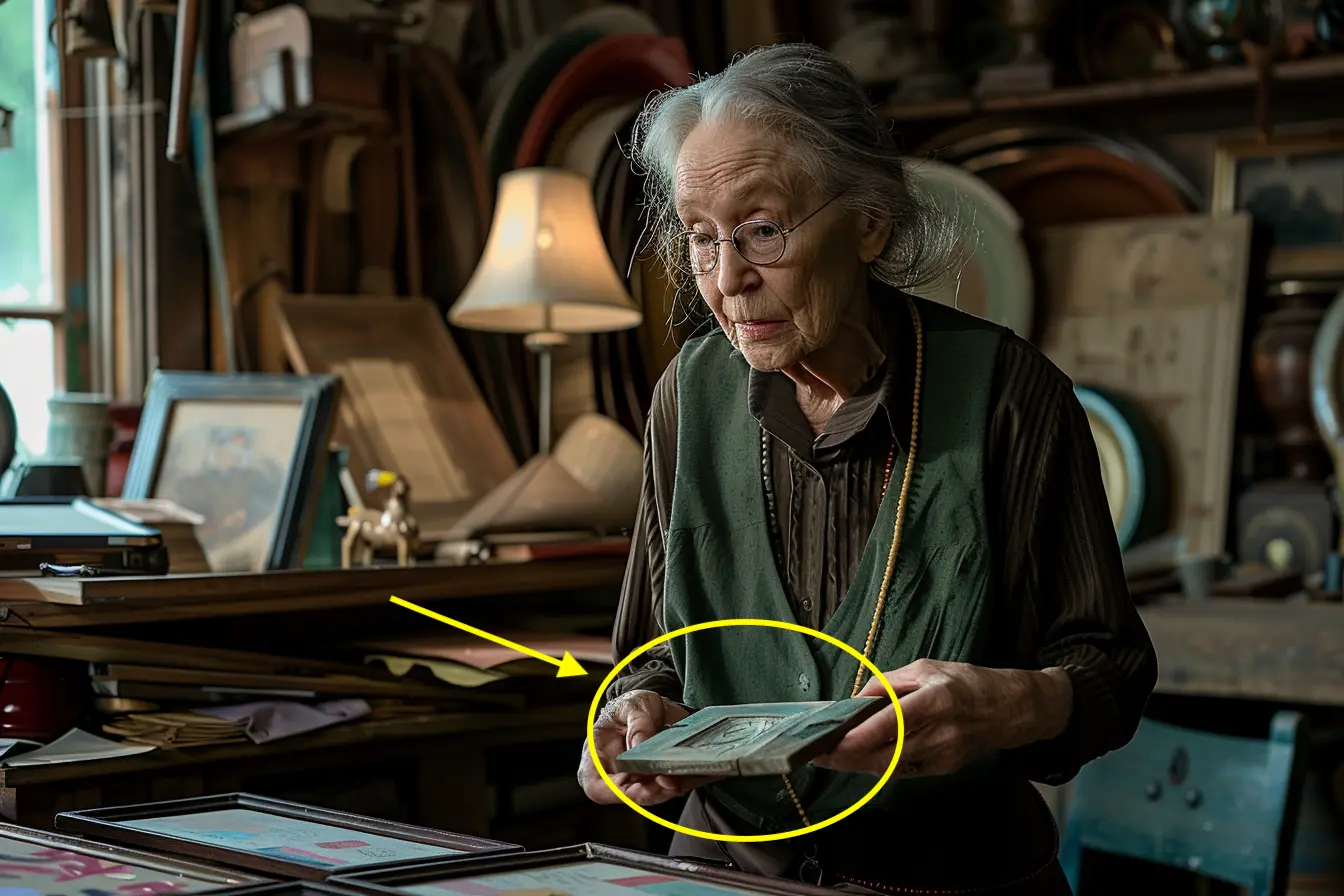
Her eyes drifted toward a shelf near the far wall. Stacked there were boxes and jars, bits of wire and cloth, the usual clutter. But one object stood out — a small wooden box half-buried beneath a tangle of old cords. Something about it caught her attention. Maybe it was the faint gleam of polished wood, or maybe it was instinct — the quiet pull of curiosity that grief often disguises as distraction.
Delilah rose and crossed the room. The box was surprisingly light when she lifted it. She brushed off the dust with the edge of her sleeve and frowned. The surface was smooth, but faintly engraved — worn letters she could barely make out. It looked handmade, the kind of thing John would have crafted himself, though she didn’t recall ever seeing it before.
For a long moment she simply held it, her heart fluttering. Then she lifted the lid.
Inside, wrapped in a square of yellowed tissue paper, was a photograph.
Delilah froze.
The photo was crisp, slightly faded at the edges, and when she saw the face in it, her breath caught. It was John — unmistakably John — standing in front of the Eiffel Tower. He was young, perhaps in his late twenties, smiling broadly, sunlight on his face. He looked happy — freer than she had ever seen him.
But there was one problem. John had never been to Paris. Not once.
Delilah’s hands began to tremble.
She turned the photograph over. The back was blank — no date, no note, no handwriting. She flipped it back again, studying every detail. His shirt, the angle of the tower, the faint blur of people in the background. It all looked real. Authentic.
Her heart pounded as questions swarmed. When had this been taken? Why had he hidden it?
A part of her tried to rationalize — perhaps it was a composite, a trick of photography, or maybe he had taken a trip before they met and simply forgotten to mention it. But even as she thought it, she knew it wasn’t true. John never forgot things. And he certainly never lied, not about something like this.
Yet here it was — proof of a life she had never known.
She sank back into the chair, staring at the photograph as if it might explain itself. The smile on his face unsettled her. It wasn’t the calm, quiet smile she remembered; it was broader, lighter, touched by a joy she hadn’t seen in years — maybe ever. There was something unfamiliar in his eyes. Something secret.
Delilah pressed the photo to her chest and closed her eyes.
“Who are you?” she whispered.
The wind outside picked up, rattling the windowpane. Somewhere in the distance, a dog barked, a sound sharp and lonely against the gathering dusk. The world felt suddenly larger, colder — as if she had stepped out of the life she thought she knew into another she didn’t recognize.
She rose again, pacing the small space, her mind racing. Maybe there were more clues. Maybe the box held something else. She searched it again, but the interior was empty except for a folded piece of tissue. No notes, no second photo, nothing.
She sat down heavily, her gaze returning to the walls lined with John’s handiwork — shelves of inventions, clocks, carvings. How many hours had he spent here, surrounded by his secrets? She remembered the nights she had come to the doorway, offering tea or dinner, and how he’d smile and say, “Just a few more minutes, love.”
Now she wondered what he had been building, or what he had been hiding.
Delilah’s grief began to shift shape — from sorrow to something sharper, more restless. A quiet anger stirred beneath her ribs. Why would he keep something like this from her? After fifty years of marriage, didn’t she deserve the truth?
She caught sight of their wedding photo on the shelf — herself in a white dress, John beside her, a faint smile under his shy eyes. She remembered how safe she’d felt that day, how certain that love meant knowing someone completely. And now, that certainty was unraveling.
“John,” she said softly into the empty room, “what did you keep from me?”
Her voice was barely a whisper, yet it seemed to echo off the walls. She waited, as if the tools or the walls might answer. Of course, they didn’t. The only reply was the steady hum of the refrigerator down the hall.
Delilah folded the photograph carefully and placed it back in the wooden box. She held the box close, almost protectively, though she didn’t understand why. It felt sacred — or dangerous. Perhaps both.
Then, for the first time since his death, she allowed herself to cry — not for the man she had lost, but for the man she might never have truly known.
As night fell, Delilah turned off the light and stepped out of the workshop, closing the door behind her. The click of the latch sounded final, yet her heart knew it was not over. Something had been set in motion — a question too large to ignore, a door that once opened could never again be shut.
In the darkness, she whispered to the silence:
“I’ll find out, John. I’ll find out who you really were.”
And though she could not see it, beyond the locked door, the faint moonlight fell across the workbench — illuminating the edge of the photograph where, half-hidden in shadow, another figure stood blurred beside John. A figure she hadn’t noticed before.
The real story is just beginning — click Next Page to find out what she uncovers…..