Chapter Twelve: Letters from France
The plane cut through the clouds, leaving behind a faint silver trail over the Atlantic. Paris faded into the distance — a mosaic of light and shadow swallowed by the horizon. Delilah sat by the window, her hands folded neatly on her lap. She had always loved the view from above: the quiet, the detachment, the illusion of leaving everything unresolved neatly behind.
But this time, she carried the past with her. It was not something she could leave in France. It had followed her into the clouds — folded inside her heart, like the letters she once kept in the wooden box now resting somewhere beneath the Seine.
Beside her, David slept lightly, his head tilted toward the aisle. He looked peaceful, though she could see the exhaustion in the lines of his face. He had tried to be strong for her, but she knew the discovery had shaken him too.
Michael. Not John.
Even now, the thought still felt unreal, as if spoken by someone else in a dream. Yet the truth was undeniable. The man who had held her through sickness, who had built a life beside her, who had whispered I love you under the weight of their years — had been his brother.
And still, she loved him. Perhaps even more for the weight he carried in silence.
She turned toward the window again. Dawn was breaking somewhere over the ocean, pale light spilling across the clouds like a promise.
When they landed in New York, the world felt heavier again — louder, more familiar, less forgiving. The air smelled of jet fuel and wet pavement. David hailed a cab while Delilah waited near the terminal doors, the hum of travelers around her blending into white noise.
She had imagined coming home differently. She had thought she’d feel relief. Instead, she felt something quieter — a sense of completion, fragile but whole.
In the cab, David turned to her. “You sure you don’t want to stay with me for a few days?”
She smiled. “No, sweetheart. I need to be home. I think the house and I have things to say to each other.”
He hesitated, studying her face. “I’m proud of you, you know,” he said finally. “For finding the truth.”
Delilah reached across the seat, touching his hand. “The truth finds us when we’re ready, not the other way around.”
He nodded, looking out the window. “I just wish Dad — or Michael, I guess — had told us himself.”
“So do I,” she said softly. “But perhaps he told us in other ways. Every day he stayed. Every word he didn’t say. Silence can be its own kind of confession.”
David was quiet for a long time after that. When the cab pulled up to her house, he helped her with her bag, lingering a little longer at the gate.
“Call me,” he said, hugging her tightly. “If it gets hard again.”
“It won’t,” she said. “Not in the same way.”
The house greeted her with silence. Dust motes drifted lazily through the soft afternoon light that filtered through the curtains. Everything was exactly as she had left it — the worn armchair by the window, the half-finished puzzle on the dining table, the faint smell of cedar from John’s — no, Michael’s — old workshop.
She walked slowly through each room, trailing her fingers along the furniture, the walls, the small artifacts of a life shared. Every object seemed different now, refracted through the prism of truth.
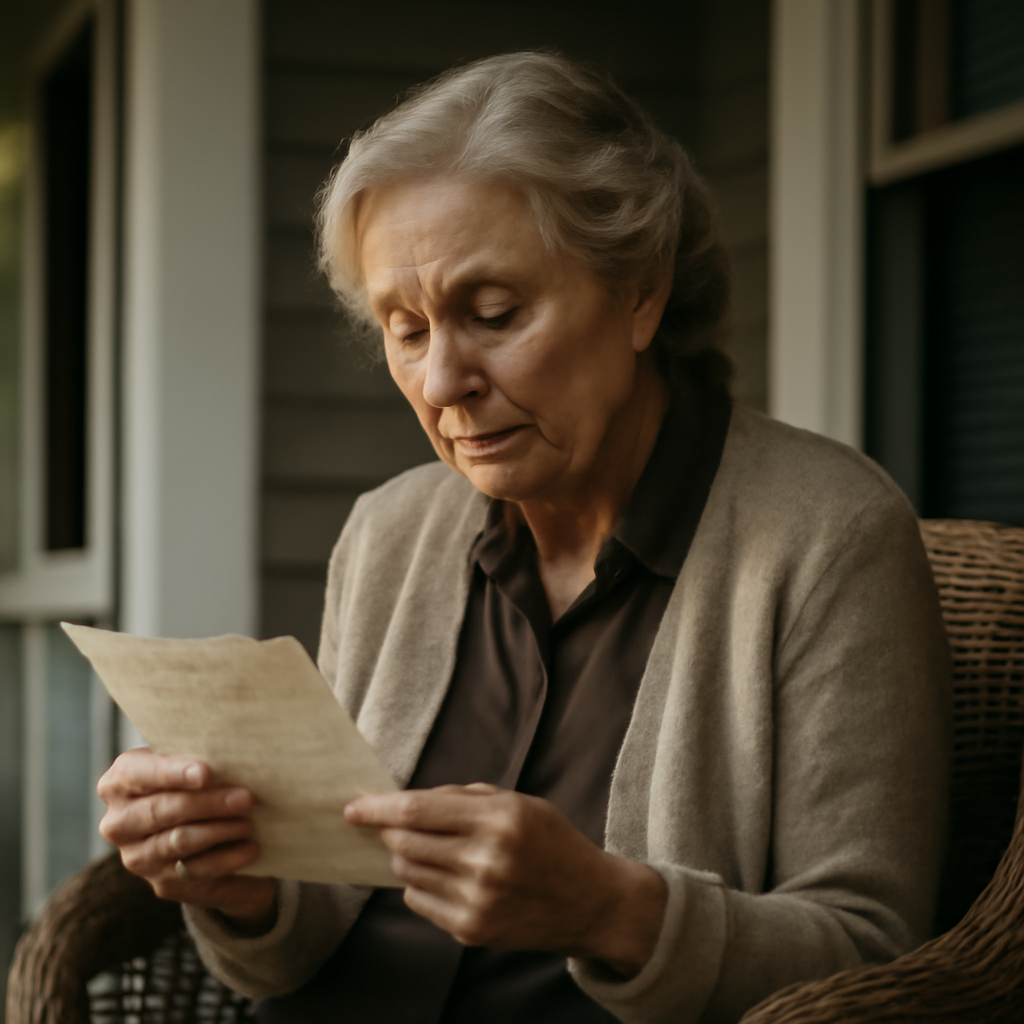
In the living room, she stopped at the bookshelf. Between a stack of old photo albums and a box of postcards, something caught her eye — an envelope, yellowed and creased, wedged deep between the volumes. She pulled it free.
Her name was written across it in a familiar hand.
Delilah.
Her breath caught.
She opened it carefully. Inside was a folded letter, its paper thin and fragile, and a small photograph tucked between the pages. The image was of the Seine — the same view from the bridge where she had released the box.
Her hands trembled as she began to read.
My Dearest Delilah,
If you are reading this, it means the past has caught up with me — with us. I tried to keep it away for as long as I could, not out of fear of you, but out of love. You gave me a life I did not deserve, and every day, I tried to be the man you believed I was.
The truth is simple, but cruel. I was not John. I was the brother who lived. The brother who envied, and who survived when he should not have. I wore his name because I could not live with my own.
But I did not live a lie, Delilah. I lived a penance — one softened only by you.
If I could ask for anything, it would be this: remember me not for the sin I carried, but for the love I gave. I hope it was enough.
Always,
Michael.
Delilah read the words again and again, tears slipping silently down her cheeks. It was as though his voice had reached across time and water to speak directly into her ear.
For the first time since learning the truth, she did not feel betrayed. She felt seen.
She pressed the photograph to her lips, whispering, “It was enough.”
That evening, Delilah sat on the porch, watching the sun dip low behind the trees. The world had changed while she was gone — the first leaves of autumn were turning gold. A gentle breeze stirred the wind chimes, their sound soft and melancholy.
She thought of Paris — of the quiet streets at dawn, of the bridge where she had said goodbye. She thought of John and Michael, of love and forgiveness, and of all the spaces between those two things.
She had once believed grief was a wound that never healed. Now she understood it differently: grief was a kind of love that had lost its form but not its purpose.
Inside, the phone rang. She let it go twice before answering.
“Mom?” David’s voice was calm, lighter than before. “I’ve been thinking. About everything.”
“So have I,” she said.
“I want to know more about them,” he said quietly. “About Dad — about Michael. I think maybe… we should tell their story. The real one.”
Delilah smiled faintly. “Maybe we already are.”
They spoke for a while longer — about memories, about life, about how truth could hurt and heal at the same time. When they finally hung up, the world outside had turned dark, the stars faint but visible through the thinning clouds.
Delilah sat in the quiet for a long time. Then she rose, went to the small writing desk by the window, and took out a clean sheet of paper.
She began to write.
To my son,
There are stories that change when you learn the truth. And there are truths that only become stories when you learn how to forgive. This is ours — not of lies and loss, but of love that refused to die.
Her pen paused. She looked toward the window, where the faint glow of the moon touched the glass.
Your father was both a man and a ghost — someone who loved deeply enough to become someone else. If that is a sin, then it is one I am willing to forgive every day.
She signed her name, folded the letter, and placed it beside the photograph of the Seine.
Then she whispered, “Goodnight, Michael,” and turned off the light.
Outside, the wind moved gently through the trees, carrying with it the faintest echo of a river half a world away. Somewhere beneath those same waters, a wooden box rested — its letters safe, its secrets surrendered.
And above it all, the city of Paris slept, its bridges arching like arms over the river — holding, forgiving, remembering.