Chapter Five: Mirror Image
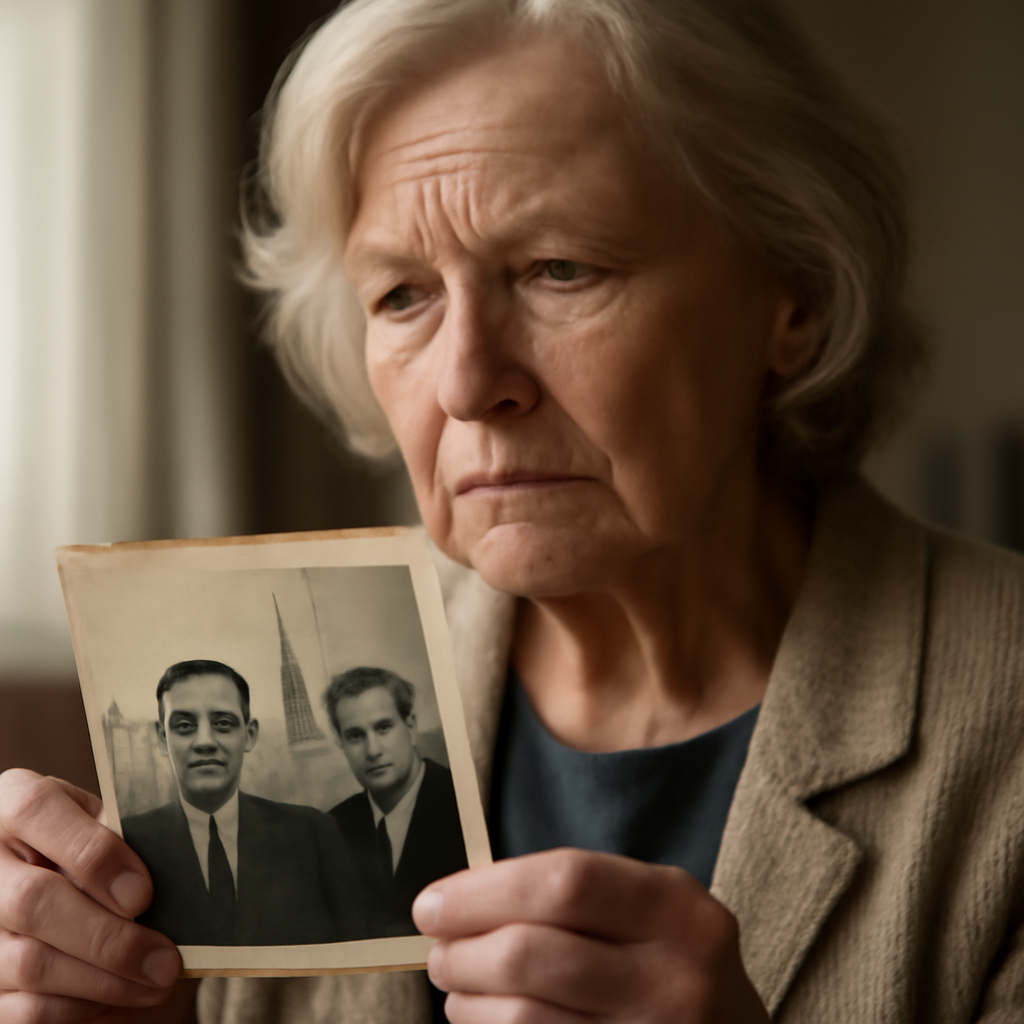
The morning sun crept hesitantly across the living room floor, revealing a space both familiar and newly foreign. The wooden box sat open on the coffee table, its contents laid out like clues in a forgotten mystery — the letter, the adoption notes, and the photograph that had changed everything.
Delilah leaned forward in her armchair, elbows on her knees, her eyes fixed on that single image once more. No matter how many times she looked at it, she couldn’t shake the feeling that something was wrong — or rather, something was missing.
She had spent the night dreaming of fire and mirrors. In one dream, John stood on a Paris street, his face flickering between two identical versions of himself — one smiling, one watching. When she woke, her pulse still racing, she had whispered aloud: It wasn’t just him in the picture.
Now, in daylight, she was determined to know for certain.
The photograph was old, perhaps fifty years or more. Its corners were soft and its colors faint, but the image itself — John, or the man she thought was John — was crisp enough to make her heart ache. Behind him, the Eiffel Tower rose against a pale blue sky. At first glance, there was nothing unusual. But the longer she stared, the more the background seemed alive, whispering secrets through its details.
There was movement — a blur of shapes, almost human, near the edge of the frame. A shadow. A figure.
Delilah’s hand trembled as she held the photo closer to the light. Her eyesight, though still sharp for her age, strained to make sense of it. There — behind the man’s right shoulder, just beyond the crowd — another man, partially obscured. The resemblance was uncanny. The same height. The same dark hair.
For a moment, her breath stopped.
“John,” she whispered. “You weren’t alone.”
A chill crawled down her spine.
She stood abruptly, crossed to the small writing desk by the window, and opened the drawer. Inside lay the envelope with Henry Caldwell’s notes — his handwriting spidery but clear: Relocated, 1962. Destination: Paris.
It was all coming together, piece by piece. The fire. The separation. The twin. Paris. The photograph was the bridge between their worlds, the proof that John had found his brother — or that his brother had found him.
But Delilah needed more than instinct. She needed clarity — literal clarity.
That afternoon, she took the photograph to the Marston Photo Restoration Studio, a small shop tucked between an antique bookstore and a florist in the old part of town. The bell above the door jingled softly as she entered.
The interior smelled faintly of dust, chemicals, and lavender. On the walls hung restored portraits and faded landscapes reborn in vivid color. A man in his sixties looked up from a light table near the counter. His white hair framed a face etched with concentration.
“Good afternoon,” he said with a polite smile. “How can I help you?”
“I was told you restore old photographs,” Delilah said, her voice steady though her heart was racing.
He nodded. “That’s what I do. Are you hoping to repair one?”
“Not exactly,” she said, handing him the picture carefully. “I want to see something more clearly. This man — my late husband — there’s someone else in the photo, I think. In the background. I need to know if I’m right.”
He took the picture gently, holding it under the lamp. His eyes narrowed in focus. “Hmm… Paris, early sixties, I’d guess,” he murmured. “Good composition, though slightly overexposed. Let’s take a closer look.”
He placed the photo on a scanner attached to a computer and adjusted the settings. The hum of the machine filled the quiet room. On the monitor, the image appeared larger, every grain and imperfection magnified.
Delilah stood behind him, her pulse loud in her ears.
The man zoomed in, slowly, toward the area she had pointed out. The shadowy blur took shape, pixels sharpening into outlines. Shoulders. A face turned slightly toward the camera.
“Oh my,” the restorer murmured.
“What is it?” Delilah asked, her voice barely above a whisper.
He looked up at her, surprise flickering in his eyes. “There’s definitely another person here. Same height. Same build. I’d even say… same face.”
Delilah’s hand flew to her mouth.
The man continued, “But that’s not all. Look closely — the one in front, your husband, I assume? He’s smiling. The one behind him… isn’t.”
On the screen, the figure’s expression was faint but visible — serious, almost cold. His eyes seemed fixed not on the camera, but on John himself.
Delilah felt a chill ripple through her body. The air in the room seemed suddenly thinner.
“Can you enhance it any further?” she asked.
“I can try,” he said, adjusting the contrast. “But the more I do, the grainier it’ll get.”
The image brightened slightly, and the two faces — mirror images of one another — grew clearer. One joyful, one solemn. The resemblance was undeniable.
Delilah stared, her throat tight. “That’s him. That’s Michael.”
The restorer turned toward her. “Who’s Michael?”
“My husband’s twin brother,” she said softly. “He thought he died when they were children.”
The man nodded slowly. “Then it seems your husband found him again — at least once.”
Delilah’s heart pounded. She could almost hear John’s voice in her mind, the way he used to say some things are better left in the past.
“Would you like a printed copy?” the man asked gently.
“Yes,” she said after a pause. “Please. One copy.”
While he worked, Delilah moved to the window. Outside, the afternoon light had turned gold, streaking the shop’s floorboards with warmth. She watched people pass by — strangers carrying umbrellas, flowers, groceries. Lives full of small, visible truths.
And yet her husband’s truth had remained invisible for decades.
When the restorer handed her the printed image, she took it with shaking hands. It felt heavier than it should have, as if the weight of the past had been pressed into the paper.
“Thank you,” she said quietly.
He nodded, his voice kind. “Whatever story this belongs to, I hope you find peace with it.”
That night, Delilah sat by the fire with the newly printed photo on her lap. The flickering light made the two faces seem almost alive, shifting subtly between shadow and flame.
John in the foreground — joyful, unguarded. And behind him, Michael — unsmiling, eyes sharp, distant.
Two men. Two lives diverged by tragedy and silence.
Delilah traced the edge of the paper with her thumb. The discovery didn’t feel like victory; it felt like grief reborn, old and raw. But beneath the ache was something else — understanding.
She could see now why John had kept the photo hidden. It wasn’t deceit. It was protection. From his guilt. From his pain. Maybe even from her.
Still, she couldn’t stop the questions that rose like smoke. Why had they met in Paris? What had happened between them? And why had John never spoken of it again?
The clock on the mantel chimed softly, pulling her back to the present. She folded the photograph carefully and placed it back in the wooden box, next to the letter. Then she rose, moving slowly to the desk where her travel documents lay open.
On top was a printed ticket — Paris, one way.
Her decision had already been made the night before, but now it felt inevitable. Whatever waited for her across the ocean, she would face it.
She turned off the lamp, letting the room fade into shadows. For a moment, she could almost imagine John sitting in his old chair by the fire, his tools in his hands, his head bowed in thought.
“I’m coming, John,” she whispered. “To finish what you started.”
Outside, the wind shifted, and rain began to fall again — soft and steady, like a heartbeat.
The next morning, Delilah packed lightly: one suitcase, her passport, the wooden box. She stood in the doorway of the workshop before leaving, looking around one last time. The familiar scent of sawdust and oil lingered, mingling with the faint echo of his presence.
She reached out and touched the back of his chair. “You could’ve told me,” she murmured. “But I suppose you were waiting for me to find out on my own.”
A weak smile touched her lips. She picked up the photograph one last time, tucking it into her purse.
Two faces stared back at her — one husband, one stranger. Two halves of a story that refused to die.
And in that instant, Delilah understood something profound: that love, like truth, has its own way of revealing itself — sometimes through silence, sometimes through loss, and sometimes through the faces of men who look exactly alike.
She turned off the light, closed the door behind her, and stepped into the morning air.
The journey to Paris — to the past — had begun.