Chapter Six: The Hidden Letters
The plane descended through a thick blanket of gray clouds, revealing a patchwork of rooftops below — Paris, pale and glimmering in the morning haze. The city stretched endlessly toward the horizon, a muted symphony of stone, iron, and memory. Delilah pressed her forehead to the window, her reflection ghostly against the glass.
She had never thought she’d come here — not at eighty-two, not without John. Yet here she was, tracing the echo of a life he’d kept hidden, a life that might still be whispering through these streets.
When the plane landed, she gathered her small suitcase and the wooden box she’d carried across the ocean. The box felt heavier than before, as though it absorbed the weight of her resolve.
At the taxi stand, the driver — a young man with tired eyes — smiled politely as she handed him a card with the address. “Rue des Carmes,” she said softly. “Fifth arrondissement.”
As the car pulled away from the airport, Delilah watched the city unfold — the narrow streets, the café terraces, the soft chatter of people moving through their ordinary mornings. Paris looked alive, timeless, unaware that it held her answers.
She arrived at a modest hotel tucked between two bookshops. The sign above the door was weathered, the gold lettering almost gone. Inside, the lobby smelled faintly of coffee and old wallpaper. The clerk — a kindly woman with salt-gray hair — checked her in with a warm smile.
“First time in Paris, Madame?”
Delilah hesitated, then smiled faintly. “Yes. Though… in a way, I feel like I’ve been here before.”
The woman handed her the key, an old brass one with the number 14 engraved on a small tag. “Then welcome back,” she said kindly.
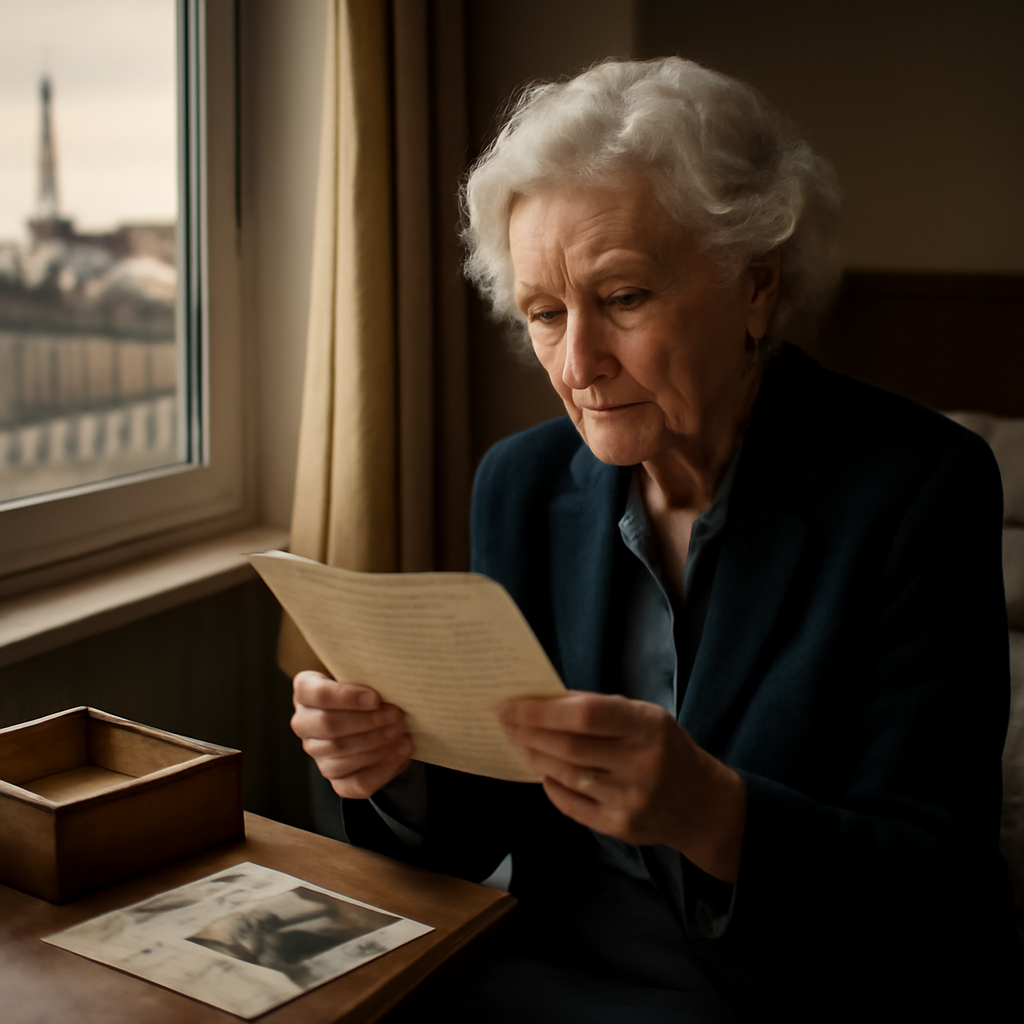
Delilah climbed the narrow staircase slowly, the carpet muffling her footsteps. Her room was small but inviting — a single bed, a writing desk, a window that opened onto the street below. She set the wooden box on the desk, her fingers lingering on its smooth lid.
“Paris,” she whispered. “We’re here.”
Outside, the bells of a nearby church began to ring, soft and resonant. She closed her eyes for a moment, letting the sound fill her chest. When she opened them again, her gaze fell to the photograph lying atop the box — John and Michael, side by side before the Eiffel Tower.
Two faces. One truth waiting to be found.
That afternoon, she began her search.
Her first stop was the Lyonnais Adoption Office, now a branch of the national archives. The building stood on a quiet street not far from the Seine, its stone façade worn but dignified. Inside, rows of old records and handwritten ledgers lined the shelves.
A clerk guided her to a research room where sunlight slanted through tall windows, dust motes swirling in the air like silent witnesses.
Delilah explained her situation — her husband’s adoption, his lost twin, the trail that had led her here. The clerk, a young woman with sharp eyes and a kind voice, listened carefully before disappearing into the archives.
After nearly an hour, she returned holding a thin, yellowing folder. “This is all we have left,” she said. “The files were partially destroyed in a flood years ago.”
Delilah opened the folder with trembling hands. Inside were a few faded documents — a transfer form, a passport application, and two letters. The first was official, dated 1962, confirming the relocation of Michael Donovan to Paris for final adoption by a couple named Moreau.
The second letter stopped her cold.
It was handwritten, unsigned, and addressed simply:
To my brother, wherever you are…
Delilah read it slowly, her lips moving soundlessly.
I’ve dreamed of you for years — your face, your voice, the way you looked at me when the fire started. I thought you were gone. I thought it was my fault. But I’ve seen the photo. I know you’re alive. I’ll be in Paris on the 14th. If you can forgive me, meet me by the river.
The letter ended there — no date, no address, only a faint smudge where a tear or drop of water had fallen long ago.
Delilah’s throat tightened. The handwriting was unmistakably John’s.
She closed the folder slowly, her hands trembling. He had come here. He had found Michael. And for some reason, he had never spoken of it again.
“Madame?” the clerk said gently. “Are you alright?”
Delilah blinked back tears. “Yes,” she whispered. “I’m fine. I just… found what I was looking for.”
But she hadn’t — not yet.
Later, she walked along the Seine, the air cool and scented with rain. The river shimmered beneath the pale afternoon sky, reflecting bridges and buildings like a mirror to the past. She imagined John walking these same paths, searching for his brother among the crowds, haunted by a lifetime of silence.
Her thoughts turned over and over like pebbles in the current. If John had found Michael, what had happened between them? Why had he returned home and buried it all?
As she reached the Pont Neuf, she paused, gripping the railing. Below, the water moved steadily, indifferent to the years, carrying secrets as old as the city itself.
It was then that she noticed something — a small antiques shop on the opposite corner, its sign painted in faded gold: Papeterie & Archives.
Something — intuition, perhaps — pulled her across the street. The bell chimed softly as she entered.
The shop was narrow, filled with the scent of parchment and time. Shelves overflowed with letters, postcards, and old photographs. Behind the counter stood an elderly man with spectacles perched low on his nose.
“Bonjour, madame,” he greeted.
Delilah smiled politely. “Bonjour. I’m looking for something… unusual.”
He raised an eyebrow. “Unusual is all we have.”
She explained her story — her husband, the photograph, the lost twin, the search for answers. The man listened intently, his expression softening as she spoke.
When she finished, he nodded slowly. “You’re not the first to come here looking for ghosts,” he said. “Sometimes they leave traces.”
He disappeared into the back of the shop. Delilah waited, her heart beating fast. When he returned, he was holding a small wooden box — older, darker than the one she carried.
“I keep letters that come without owners,” he explained. “Found in attics, trunks, estate sales. Sometimes they find their way to the right hands.”
He set the box on the counter and lifted the lid. Inside were dozens of old envelopes, tied with ribbon. He untied one bundle and pulled out a letter. The paper was yellowed, the handwriting familiar.
Delilah’s breath caught. “That’s his,” she whispered.
The man handed it to her carefully. “Take your time.”
She unfolded it, her eyes scanning the page.
Paris, 1963
Michael,
I didn’t know what I’d find here. I didn’t know if you’d even remember me. But when I saw you on the bridge, I knew. You looked just like I did before the fire. The same eyes, the same fear. I wanted to run to you, but I couldn’t. You turned away before I could speak.
Maybe you’ll read this one day. Maybe you’ll forgive me for surviving.
Delilah’s tears fell freely now, blurring the ink. She could almost hear John’s voice, trembling, burdened with love and shame.
The shopkeeper watched quietly, his own eyes soft with understanding. “Sometimes,” he said, “we keep the letters we never meant to send.”
Delilah folded the paper carefully and held it to her chest. “Thank you,” she whispered. “You’ve given me a piece of him I never had.”
The man nodded. “Keep it safe. Some stories deserve to be finished.”
That evening, back in her hotel room, Delilah spread the letters across the bed. The rain had started again, tapping softly at the window. Candlelight flickered over the pages, casting long shadows on the walls.
She read each letter in silence — words of longing, regret, hope. Through them, she pieced together the truth: John had come to Paris, had found Michael, but the reunion had not gone as he dreamed. Michael had refused to see him. The past was too heavy, too burned.
The last letter ended with only three words:
I forgive you.
It was written in a different hand — smaller, sharper, more deliberate.
Michael’s.
Delilah pressed her hand to her mouth, a sob breaking free. The brothers had found peace, but only after she had been left behind.
She gathered the letters and placed them gently in her wooden box, beside the photograph. The two brothers — one smiling, one solemn — stared up at her through time.
“You both carried this too long,” she whispered. “It’s my turn now.”
She closed the lid.
Outside, the bells began to ring again, echoing across the Parisian rooftops. The sound was deep and resonant, filling the small room like a heartbeat.
Delilah wiped her tears and smiled faintly. For the first time since John’s death, she felt something like peace — fragile, luminous, and real.