Chapter Ten: A Journey Begins
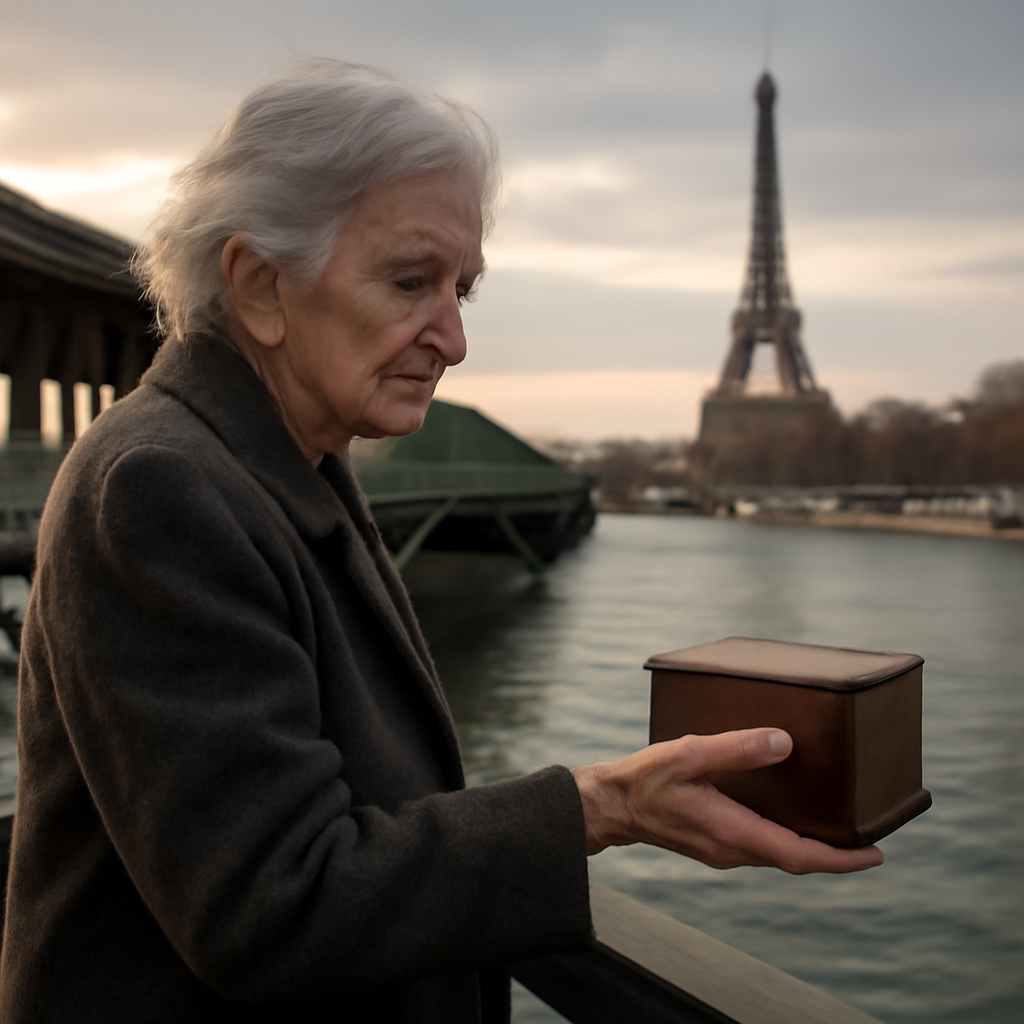
The wind along the Seine was colder that evening, though it carried the faint scent of rain and river stone. The sky had begun to darken, Paris slowly dissolving into shades of silver and blue.
Delilah stood on the bridge, the same bridge written in the adoption file — Pont de Bir-Hakeim. The truth pulsed in her chest like a wound that would not close.
John hadn’t come home. Michael had.
She gripped the railing tightly, her knuckles pale against the iron. Below, the river moved with quiet indifference, its surface reflecting the dying light. She felt small against its vastness — a woman adrift in a story she had thought she understood, now rewritten beneath her feet.
For fifty years she had loved him — his gentleness, his quiet humor, the way he had held her hand during every hardship. And yet, that love now trembled beneath the weight of a single unbearable thought: Had she loved a lie?
But even as the question formed, another voice — softer, more forgiving — whispered back: Or had she simply loved the man he had become?
She returned to the hotel in silence. The city lights blinked like small, indifferent stars beyond the window. The wooden box sat on the table where she had left it, its surface gleaming faintly in the lamplight.
For a long time, she stared at it without moving.
Inside lay the life she had built from fragments — the letters, the photographs, the truths half-told. And yet, for all her searching, one truth still eluded her: Why had Michael chosen to live as John?
Was it guilt? Survival? Redemption?
She imagined the scene from sixty years ago — two identical men on a Paris bridge, rain falling softly between them. John reaching out. Michael turning away. A scuffle, perhaps. Raised voices. Then silence.
Had it been an accident? A desperate moment of rage or grief?
Delilah pressed a hand to her chest, trying to calm the trembling in her heart. “You should have told me,” she whispered. “You should have trusted me with the truth.”
But she knew, deep down, why he hadn’t. Because to speak it aloud would have destroyed them both.
The next morning dawned bright and cold. Paris looked reborn — washed in pale light that glittered across the rooftops. Delilah stood before the mirror, fastening the simple pearl earrings John had given her on their 25th anniversary. She no longer knew who had truly given them — John or Michael — but the memory of that day was real, and that was enough.
She packed her things slowly, folding her clothes with careful precision. At the bottom of the suitcase, she placed the wooden box and the letters, as if laying a body to rest.
Before leaving, she took one last look around the room. The walls held no memory of her stay, yet she felt them watching her all the same. “Goodbye,” she said softly, not to the room, but to the ghosts that filled it.
At the front desk, the clerk smiled warmly. “Leaving us already, Madame Davis?”
“Yes,” Delilah replied. “It’s time.”
The woman tilted her head. “Did you find what you were looking for?”
Delilah paused, the corners of her mouth lifting into a faint, tired smile. “I found something,” she said. “Maybe not what I expected — but something true.”
The clerk nodded, as if she understood. “Then Paris has done its job.”
Delilah took a cab through the city one last time. The driver spoke little English, but he seemed kind. When she asked him to stop near the river, he nodded and pulled over by the embankment where the view stretched wide and endless.
She stepped out, her shoes crunching lightly against the wet cobblestones. The air smelled of metal and morning, tinged with the faint sweetness of bread from a nearby bakery.
The Seine flowed quietly, its surface catching the light like liquid glass. She stood there for a long time, holding the photograph in her hands — the same one that had haunted her for weeks. Two men. One smiling. One shadowed. And somewhere, just out of sight, the figure who had taken it all away.
She took a slow breath and spoke aloud, her voice trembling but clear.
“I know now,” she said. “And I forgive you — both of you.”
Her reflection shimmered in the water below, older, softer, yet somehow stronger than before.
A sudden memory rose within her — not of grief, but of tenderness.
It was years ago, in the kitchen of their old home. Michael — though she’d believed him John — had been fixing the radio. She had teased him for never asking for help, and he had smiled that half-smile she adored.
“You’d help me too much,” he’d said playfully. “Then I’d forget how to do things on my own.”
Even then, she realized, he had been a man trying to rebuild a life from ruins.
And she — unknowingly — had been part of his salvation.
Tears welled in her eyes, not of sorrow, but of understanding. Love, she thought, had always been both fragile and fierce — capable of surviving even the deepest deception.
Because love wasn’t about names or histories. It was about presence. About showing up every morning, even when the past refused to stay buried.
Delilah walked along the riverbank, her steps slow but certain. She stopped where the bridge arched gracefully over the water — Pont de Bir-Hakeim, the place where everything had begun and ended.
She opened the wooden box one final time. Inside, the letters rested neatly together, along with the photograph. For a moment, she traced the edges of the image with her thumb, memorizing the faces of the two men she had come to love — one as her husband, the other as the truth she had finally met.
Then she closed the box, her fingers steady.
“You’ve both carried enough,” she whispered.
With one last look at the city around her — the quiet water, the gray sky, the faint hum of life continuing — she leaned forward and released the box into the river.
It slipped beneath the surface without a sound, swallowed by the current. Ripples spread outward, widening, fading, until the water stilled again.
Delilah stood watching, tears sliding silently down her cheeks. For a moment, she thought she saw two shadows reflected in the water beside her — brothers, side by side, at peace at last.
She smiled through her tears.
When she finally turned to leave, the city seemed softer somehow — as if it, too, had exhaled. The sky began to lighten, streaks of gold breaking through the clouds.
At a nearby bench, she sat to rest. The world around her felt quiet, but not empty. Children laughed in the distance. A couple passed by, holding hands. Life, ever patient, continued.
Delilah took a deep breath and looked down at her hands — old, wrinkled, but steady. For the first time in years, she felt the faint stirrings of peace.
She didn’t know what waited for her back home, or how she would explain what she had discovered. Perhaps she wouldn’t explain it at all. Some truths were too fragile for words.
But she knew one thing: her journey wasn’t ending here. It was beginning.
That night, on the flight back to New York, Delilah sat by the window, the city lights of Paris fading beneath her like constellations. She touched the small pendant around her neck — a simple locket, empty now, but warm against her skin.
As the plane rose higher, she whispered a final goodbye to the brothers she had loved — one in life, one in memory.
Below her, the river shone faintly, winding like a thread of silver through the heart of the city — carrying away what was lost, and leaving only what was true.
Somewhere far below, the wooden box drifted gently along the Seine, its contents safe within — letters, photographs, and the unspoken bond of two men who had shared not just a face, but a fate.
And as it moved toward the open water, a faint sun broke through the clouds above, touching the surface with light.