Chapter Three: Echoes of the Past
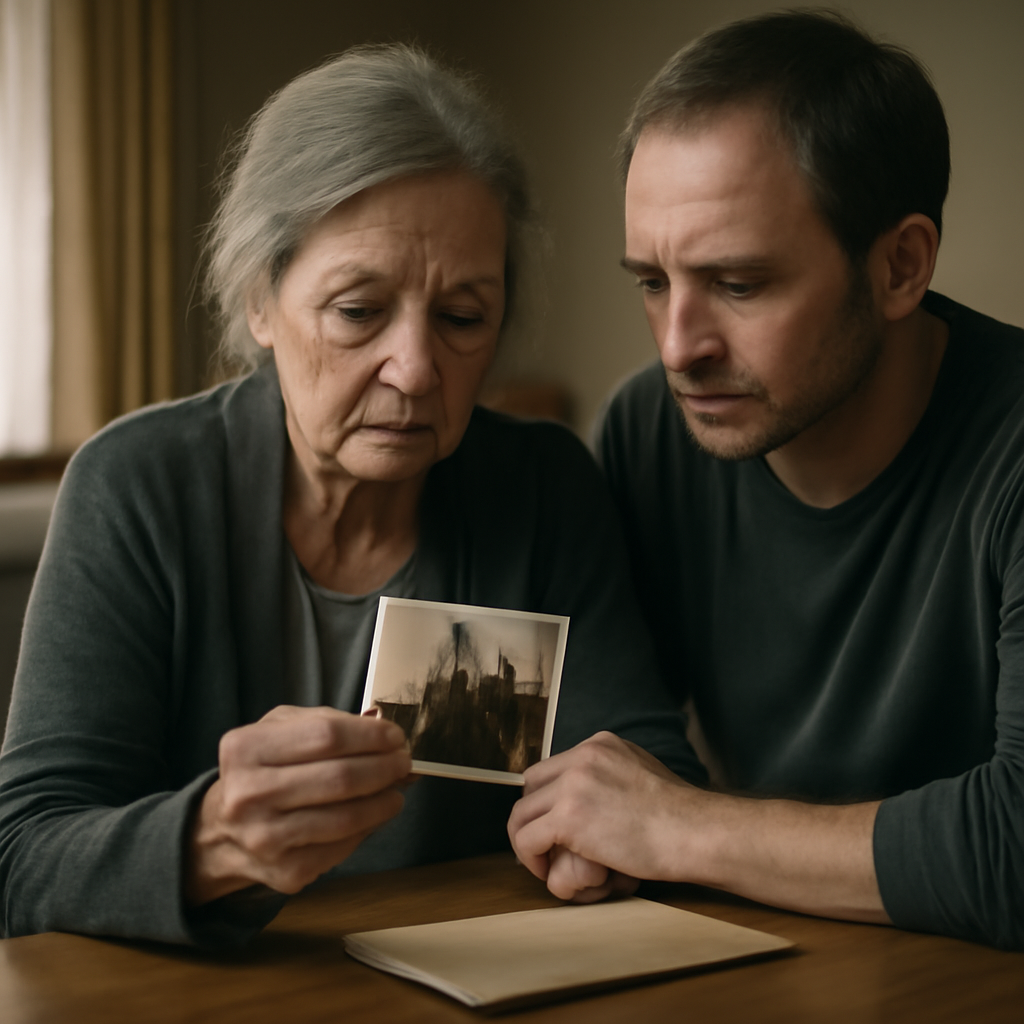
The afternoon sunlight filtered weakly through the lace curtains, drawing thin white lines across the wooden floor. The air was still, but heavy — the kind of quiet that pressed down on the chest, making every breath deliberate.
Delilah sat at the kitchen table again, her back straight but her eyes distant. The photograph lay in front of her like a question that refused to be answered. Her tea had gone cold.
Margaret’s words echoed in her mind, circling like restless birds: John had a twin brother.
Even now, saying it silently to herself felt unreal. How could she have spent more than half a century with a man, shared his bed, his dreams, his fears — and never once heard about something so monumental? A brother. A lost part of him.
Her gaze softened as she studied John’s face in the photograph. “What were you hiding from me?” she whispered.
The kitchen clock ticked steadily, its rhythm almost soothing, but she couldn’t escape the growing disquiet. There was something missing in all of this — something buried. And the more she thought about it, the more she felt compelled to dig deeper, even if it meant unearthing truths she wasn’t ready for.
Her thoughts were interrupted by a voice from the hallway.
“Mom? You alright?”
She turned. Her son, David, stood in the doorway, his tall frame casting a long shadow across the floor. His expression was filled with the same quiet worry he’d worn since the funeral — that mixture of tenderness and helplessness only adult children could have when they realized their parents had become fragile.
Delilah tried to smile, though it didn’t quite reach her eyes. “I’m fine, sweetheart. Just thinking.”
David walked in and sat opposite her, his brow furrowed. He glanced at the photo on the table. “You’ve been sitting here for hours. Is that Dad?”
She nodded, sliding the photo toward him. “It’s from his workshop. I found it in a box he kept hidden. Look closely, David. He’s in Paris — the Eiffel Tower. But he never told me he’d been there.”
David frowned, leaning closer. “That’s strange. Maybe it was before you met?”
“I thought that too,” Delilah said softly. “But even then… he would’ve mentioned it, wouldn’t he? We shared everything.”
David turned the photo over, found nothing written, and handed it back. “You think there’s more to it?”
Delilah hesitated, her heart heavy. “I called Margaret. She told me something… something I didn’t know.”
David’s eyebrows lifted. “What?”
“She said your father had a twin brother.”
For a long moment, David said nothing. His jaw slackened slightly as he processed the words. “A twin?”
Delilah nodded. “Yes. Separated when they were children. He never told me. Not once.”
David leaned back, exhaling slowly. “That’s… wow. I mean, I don’t even know what to say.”
“I don’t either,” Delilah admitted, her voice trembling. “I keep wondering why he’d hide something like that. All these years, and not a word. It makes me feel like I didn’t know him at all.”
David reached across the table, placing his hand over hers. “Mom, I’m sure Dad had his reasons. You know what he was like — quiet, private. Maybe it was too painful.”
“Painful,” she repeated, the word tasting bitter on her tongue. “Yes, maybe. But it was part of him, part of who he was. And if he carried that pain alone, then I failed him, didn’t I? I should’ve seen it.”
David shook his head. “You didn’t fail him. You gave him a good life, Mom. That’s what mattered.”
Delilah looked down at their joined hands, her heart aching with both love and loss. “Still,” she whispered, “I can’t stop thinking about it. About what else I don’t know.”
David studied her face for a moment, then said carefully, “Maybe there’s a way to find out. You could talk to the adoption agency — see if they have records. They might know what happened to Dad’s brother.”
She looked up, surprised by the idea. “Do you really think they’d tell me?”
“They might,” David said. “If not, maybe we could find a way to get access. It’s not impossible.”
Delilah felt a flicker of resolve beneath her grief. Yes, she thought. She had to know. For herself, for John, maybe even for the brother who might still be out there.
That evening, as the house fell into shadows, Delilah gathered her things — her purse, her coat, and the small wooden box that had started it all. She couldn’t bring herself to leave it behind.
The next morning, the adoption agency’s office was quiet and cool, filled with the faint scent of paper and polished wood. A receptionist with kind eyes greeted her.
“Good morning, ma’am. How can I help you today?”
Delilah smiled faintly, trying to steady her nerves. “I’m looking for information about my late husband. He was adopted through this agency many years ago — John Davis.”
The receptionist’s fingers danced across her keyboard. “Do you know approximately when the adoption took place?”
Delilah nodded. “Around 1956. He was thirteen.”
The woman typed a few more words, then frowned slightly. “I’m afraid those records are sealed, ma’am. Adoption files from that era are considered confidential. Only direct descendants or legal guardians can request access.”
Delilah’s heart sank. “But I’m his wife. He’s gone now. I just want to understand where he came from.”
“I understand,” the receptionist said sympathetically. “But without a court order or authorization from the state, I’m not allowed to release personal details.”
Delilah felt frustration rising. She pressed her palms flat on the counter. “Please. There must be something you can tell me. Anything.”
The woman hesitated. Her gaze softened. Then she said quietly, “Wait here a moment.”
She disappeared into the back office. Delilah waited, her pulse quickening. After a few minutes, the woman returned holding a slip of paper. She slid it across the counter.
“I can’t give you the file,” she said, lowering her voice, “but I can tell you this much: John Davis’s adoption record referenced a second child — same birth date, same place. His name was Michael Donovan. That’s all I can say.”
Delilah stared at the paper, the name blurring through her tears. Michael Donovan.
It was real. Not a rumor, not imagination — a name, a person.
“Thank you,” she whispered.
The receptionist gave a small nod, then quickly tucked the file back into its place. “I’m sorry, ma’am. That’s all I can do. Good luck.”
Delilah stepped outside into the cold afternoon air, clutching the paper like a lifeline. The city felt louder than usual — cars, voices, the wind pushing through the trees. She leaned against the wall for a moment, trying to breathe.
Michael Donovan.
Her husband’s brother. The other half of a story that had never been told.
When she returned home that evening, David was waiting at the table, sorting through old boxes from the attic. “Any luck?” he asked.
Delilah nodded, setting her purse down. “I found his name. Michael Donovan.”
David’s eyes widened slightly. “That’s incredible. Do you think he’s still alive?”
“I don’t know,” she said softly. “But if he is, he’s out there somewhere — and he might have the answers your father never gave me.”
David reached for one of the boxes. “Maybe there’s something here too. Letters, photos, anything.”
Together they opened the old boxes, sifting through yellowed papers, postcards, and scraps of John’s handwriting. Most of it was mundane — receipts, sketches, broken clock parts — but one envelope caught Delilah’s eye. It was unmarked, sealed, and tucked between the pages of an old manual.
Her heart quickened. She tore it open carefully.
Inside was a folded piece of paper — a letter written in John’s unmistakable script.
“If you’re reading this, Delilah, then I never found the courage to tell you myself. Some things are too heavy to carry into the light. I once had a brother — Michael. We were together when the fire happened. I survived. He didn’t… or so I thought.”
“But one day, I saw a photograph. A man in Paris who looked exactly like me. I never knew if it was real. I wanted to believe it, but fear kept me silent. Fear that you’d see the part of me that never healed.”
“If you find him — or the truth — forgive me for not telling you sooner.”
Delilah’s hand trembled as she lowered the letter. Her throat closed around a sob she couldn’t contain. David placed a hand on her shoulder, silent.
The room felt charged — not just with sorrow, but with revelation.
So that was it. The photograph wasn’t only proof of John’s hidden past; it was a message. A breadcrumb he had left for her to find, long after he was gone.
Delilah folded the letter carefully and slipped it back into its envelope. The decision formed in her mind even before she spoke.
“I have to find him,” she said quietly.
David looked at her, startled. “Mom, you mean his brother? You don’t even know if he’s alive.”
“I have to try,” she said firmly. “For John. For me.”
Her eyes, though red and tired, shone with new purpose. For the first time in weeks, she felt alive again — not in the way she used to be, but in the way that comes when grief begins to turn into action.
The photograph, the letter, the name — they were all pieces of the same puzzle. And she would follow them wherever they led.
Outside, the evening sky deepened into indigo. The wind carried the faint scent of rain and something else — something like renewal.
Delilah looked down at the photograph one last time. The man she had loved stood smiling before the Eiffel Tower, the ghost of another man reflected faintly beside him.
“Echoes of the past,” she murmured. “And I’m coming to find you.”