
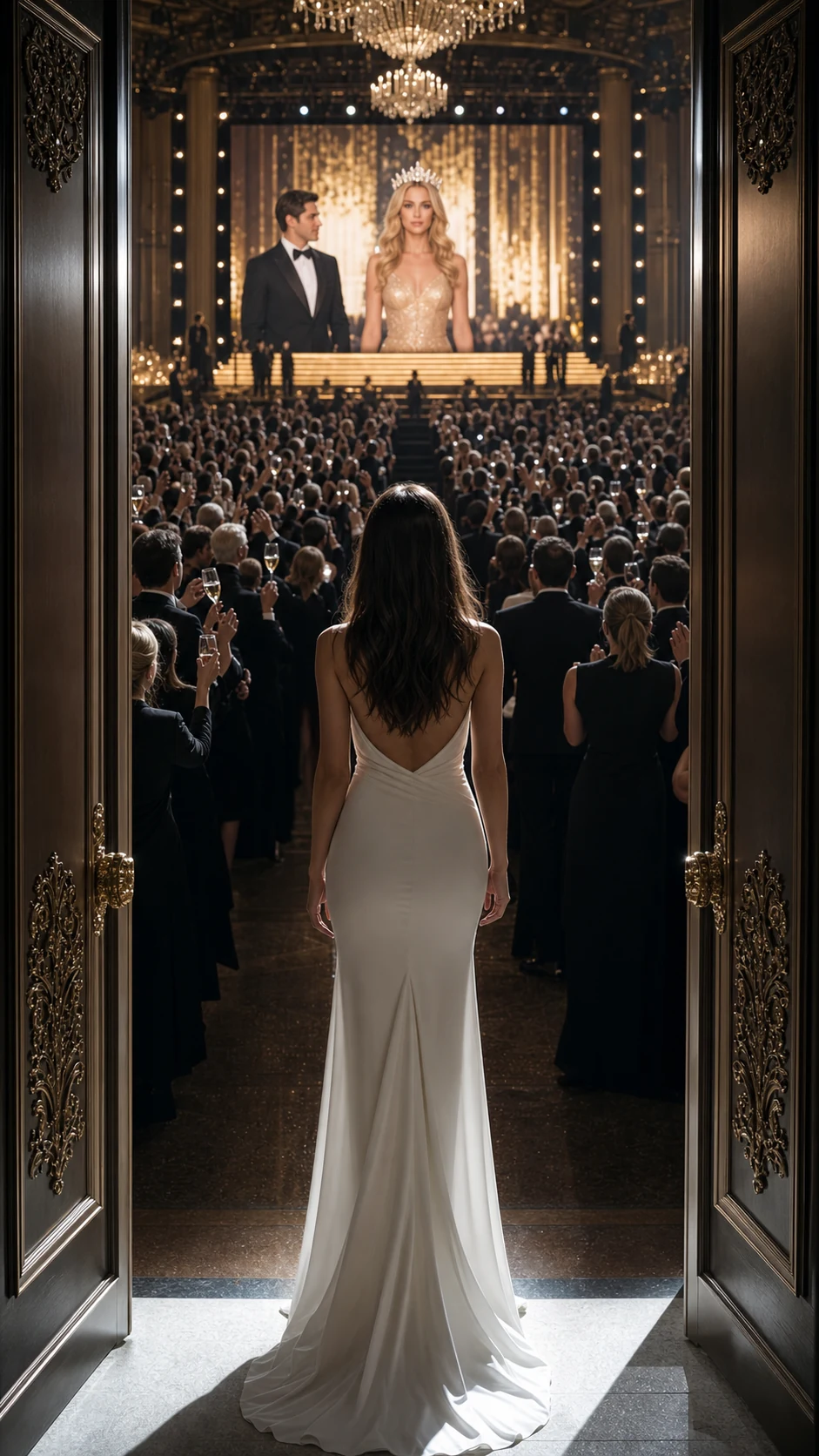
Chapter 1: The Crown Was Hers
The crown was cut from window glass, and every person clapping under that dome believed it was diamonds.
It wasn't. My mother had no patience for diamonds. When Sterling's biotech division cleared its tenth year she had the old research-room windows taken out during the refit and nine pieces cut and polished from them, and she had them mounted on a plain silver band, and she called the result a joke about scientists inventing a monarchy nobody had asked for. She wore it exactly twice. Both times she looked embarrassed.
Celeste wore it like she'd been fitted for it.
Six hundred people were on their feet in the atrium. My father had her hand raised in his, the way you present a thoroughbred, and he was saying something about the next hundred years of Sterling innovation, and the phrase he used was my daughter.
He has two. He has always had two. It's a peculiar thing to stand in a doorway and hear a man edit his own arithmetic in public.
They had cropped the centennial portrait, too. I noticed that before I noticed anything else, because I knew the original — my parents at the old Elmsworth site, me at fourteen between them holding a culture plate I'd been allowed to carry eleven metres. The version projected on the wall that night had been cut down to my father and the company logo, and the crop line ran directly through where my shoulder had been.
I stood at the back in a white dress and nobody turned around for four minutes.
Nathan was one step below her on the riser, close enough that every camera flash found the ring she'd been wearing since March and announcing since June. There was a courthouse lobby, years ago, where he took both of my hands and told me that no board and no headline and no frightened investor would ever make him doubt what he knew about me. I have thought about that sentence more than I have thought about most people I've loved. It was true when he said it. That's what makes it interesting.
Then a woman in the AURORA-9 study had a severe reaction, and the records stopped saying what they had said, and Nathan testified, and I was gone. Four things, in that order, inside eleven days.
"AURORA-9 began as something I was told was impossible," Celeste said, taking the microphone out of our father's hand. "I believed a damaged system could be given a second chance. Others weren't willing to keep going."
The room laughed, warmly, at a line she'd clearly practised in a car.
Others. Singular. Standing forty metres behind her in a white dress.
The screen came up behind her then, three metres of it: a glass culture chamber, photographed in my laboratory, on a bench I had specified, and across the bottom in gold —
CREATED BY CELESTE STERLING.
I had the invitation in my hand. I found later that I'd folded it in half without noticing.
Julian was outside with the lawyers. He'd offered to come in beside me and I'd said no, and he hadn't argued, which is most of what I can tell you about why I work for him. If I walk in behind a powerful man, my sister gets to spend a year explaining that the man is the reason I came back.
"Tonight," Celeste said, "I accept the role of chief executive officer, and I promise you that the research I built will finally become what it was always meant to be."
My father lifted his glass. "To Celeste."
Six hundred people stood up.
I started walking.
An old director on the aisle saw me first — Harold Vance, who taught me to play backgammon badly when I was six. His glass stopped about an inch below his mouth and stayed there. The woman beside him followed his eyes. Then a photographer turned, and after that it went through the room faster than the applause had: voices thinning out row by row, glasses coming down, six hundred people arriving at the same realisation at slightly different speeds.
Nathan got there last, or pretended to.
His face didn't move. He has spent five years building a face that doesn't move and I'll grant him that it's excellent work.
But his hand came off my sister's waist.
My father simply stopped, mid-gesture, like a machine finding an obstruction.
Celeste kept smiling for three full seconds after the room had gone quiet, which is the longest I have ever seen anyone smile at nothing.
Then she found me.
"Evelyn," she said, into a live microphone, and my name went out through the speaker array they'd rented to announce her.
Two security officers started down the side. I kept walking up the middle — past investors who had described me as unstable to journalists, past the journalists who printed it, past four people I hired myself, all of whom found something fascinating about the floor.
Celeste recovered faster than any of them. I have never once been able to deny she's quick.
"This is a private celebration," she said. "Although perhaps my sister has come to congratulate me."
I stopped at the foot of the riser, close enough to see the scratch above the centre stone.
I put that there. I was twelve, and my mother let me carry the crown from the case to the display table, forty steps, and I caught it on a brass fitting and spent the next hour convinced I had destroyed something irreplaceable. She told me the scratch made it hers now instead of the jeweller's.
Celeste saw where I was looking and lifted her chin.
"Do you like it?"
"It was never yours."
"The board disagrees."
"The board gave you a title."
I looked up past her at three metres of my own laboratory with her name under it. Then at my father. Then at the man I'd nearly married.
"You crowned the wrong scientist."